
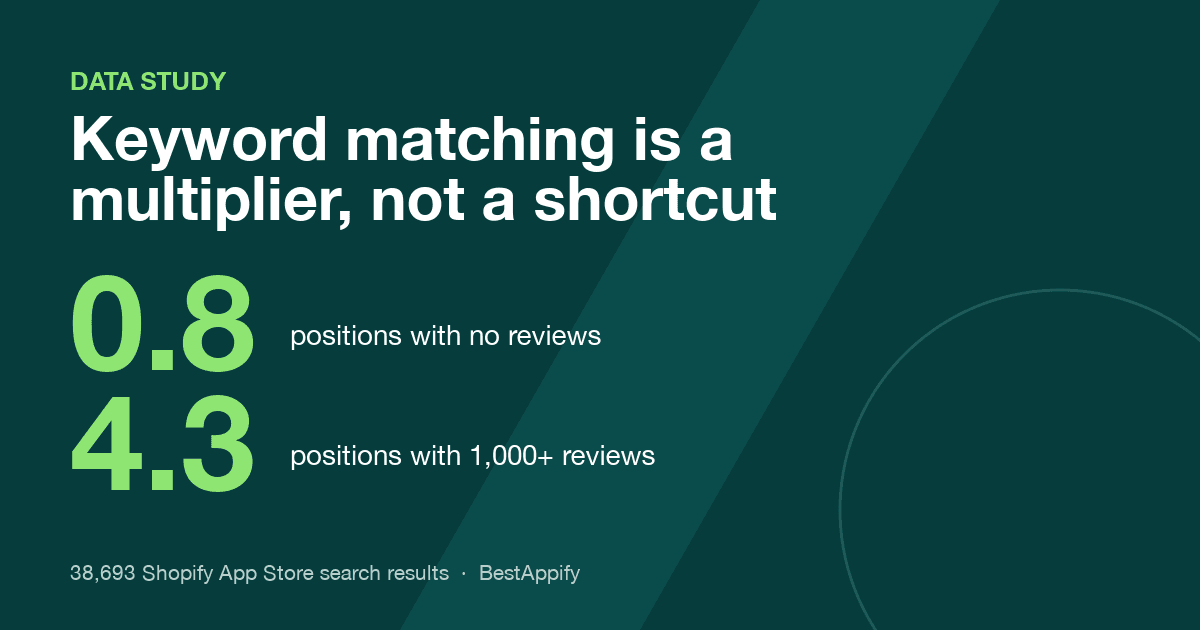
Putting the exact search phrase in your app's name and tagline does move rank — but it is worth 0.8 positions if you have no reviews and 4.3 if you have thousands. The lever the advice industry sells hardest to new apps is the one that helps them least.
Keyword Matching Is a Multiplier, Not a Shortcut. We Checked 38,693 Search Results
Every guide to ranking a Shopify app says the same thing: put the search term in your name and your tagline. It is the cheapest advice in the ecosystem, and almost nobody who gives it has checked whether it works.
We crawl the App Store every day, so we could check. This study takes 1,784 non-brand search terms, roughly the top 24 results for each, and asks one mechanical question of every result: does the exact search phrase appear in that app's name, or in its 170-character tagline? Not "is it about that topic" — the literal phrase, lowercased and punctuation-normalised. That gives 38,693 term-to-app pairs covering 7,950 distinct apps, snapshotted between 13 August and 2 September 2026.
The short answer: matching works, it keeps working after you control for how big an app is, and it is worth the least to exactly the apps that are told to rely on it.
About half the top slots repeat the phrase
Of the number-one results, 45.1% contain the exact search phrase somewhere in the name or tagline — 40.2% in the name, 23.3% in the tagline. Restrict that to the 1,285 terms whose most recent crawl is free of duplicate rows and it rises to 54.7%. Call it about half, and treat the spread as the honest error bar rather than a single decimal.
Either way the conclusion holds: literal matching is neither necessary nor sufficient. Roughly half the head of the page goes to apps that never say the words. But the gradient down the results is steep and consistent:
| Position | Exact term in tagline | Exact term in name | Median reviews |
|---|---|---|---|
| 1–3 | 23.4% | 34.8% | 194 |
| 4–10 | 18.5% | 22.0% | 101 |
| 11–25 | 13.1% | 13.4% | 52 |
Two things move together there, and separating them is the rest of this post: apps at the top match the query more literally and they have roughly four times the reviews.
Two searches that show both halves
Here is the top of "google sheets", as our crawl saw it on 26 August:
- Exportsy Sync To Google Sheets — 26 reviews
- eCommix ‑ Google Sheets Sync — 19 reviews
- FlexSync: Google Sheets Sync — 15 reviews
- Shopify Flow — 11,978 reviews
Three apps with sixty reviews between them sit above Shopify's own automation app, which has twelve thousand. All three carry "Google Sheets" in the app name and in the tagline. Shopify Flow's tagline talks about "custom workflows to automate marketing, order fulfillment, inventory management" — an accurate description of a much bigger product that happens not to contain the phrase a merchant types when they want their orders in a spreadsheet.
Now "review app", from the crawl of 25 August:
- Judge.me Product Reviews App — 46,652 reviews
- AG Product Reviews App & UGC — 3,026 reviews
- Loox ‑ Product Reviews App — 8,997 reviews
- Junip Product Reviews App & AI — 1,087 reviews
- Trustify: Product Reviews App — 413 reviews
Something worth noticing: by our own matching rule, none of these six contains the phrase "review app". They all say "Product Reviews App" — plural — which does not contain the singular phrase a merchant typed. Nobody in the visible results won this term by repeating it. The order is close to a ranking by weight, and the top slot belongs to the app with forty-six thousand reviews.
So on a broad, fought-over term, matching is not what is being rewarded. On a narrow term like "google sheets", matching is the winner. Which of those two situations you are in is mostly decided before you write a word of copy — we measured that separately in our study of which searches are winnable at all.
The effect survives controlling for reviews — and it compounds
Split every pair into review buckets and compare the mean position of apps that match the term in their tagline against those that do not, within the same bucket:
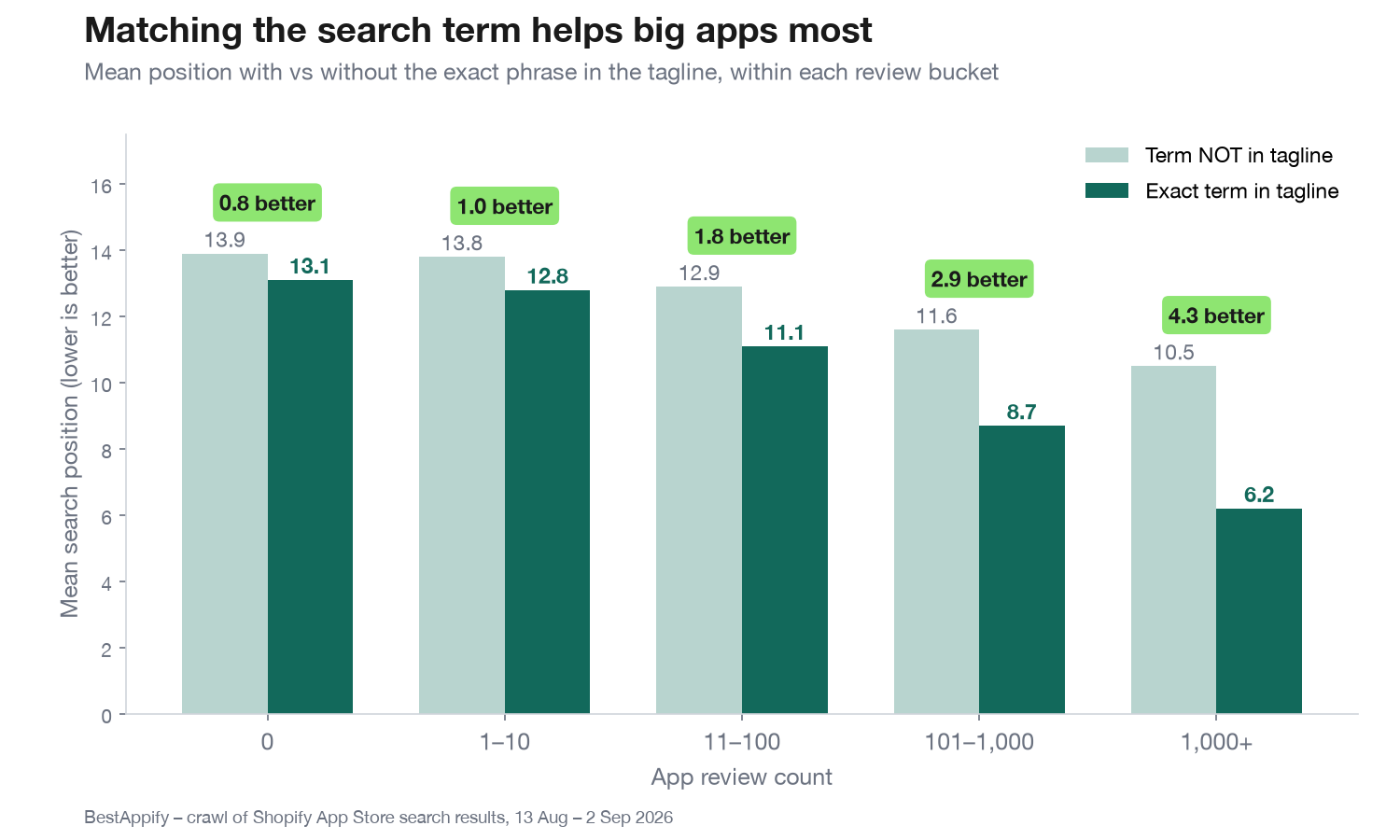
If you have no reviews, saying the words is worth about eight tenths of a position: fourteenth instead of thirteenth, which is worth nothing at all. If you already have a thousand reviews, it is worth more than four positions — the difference between the visible part of the page and the scroll.
Keyword matching is a multiplier on authority, not a substitute for it. That is the opposite of how the advice is usually applied. Founders rewrite their listing copy because they have no traction, which is precisely the state in which rewriting the copy does the least.
Where small apps actually do win
"Get more reviews first" is useless advice, so we looked at who actually holds the top three. Of 5,590 top-three slots across all terms, 38.0% belong to apps with fewer than 100 reviews. The head of the page is not sealed.
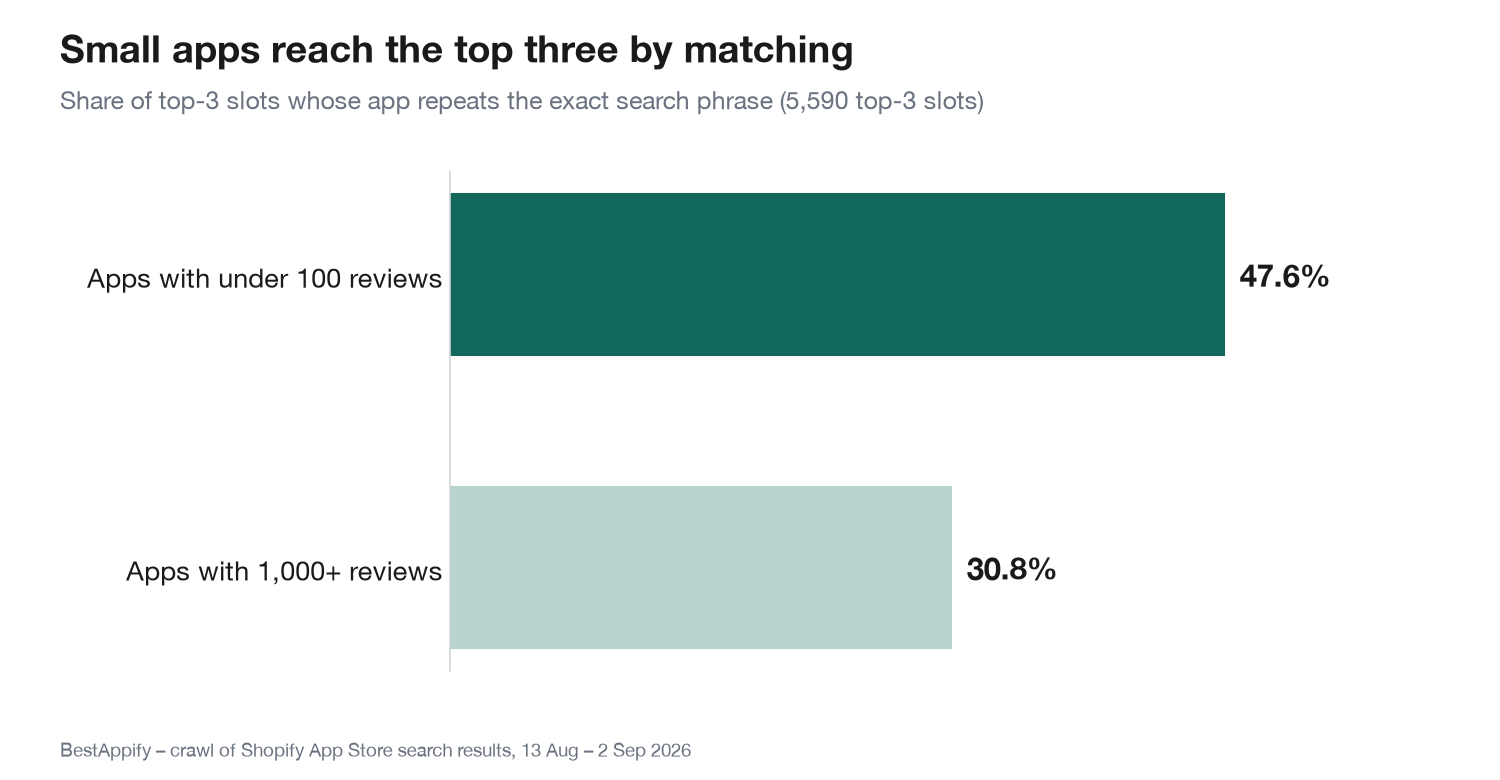
Small apps get to the top by matching. Big apps get there by being big. If you are small, the literal match is not a nice-to-have — it is close to the only mechanism available to you.
An aside: the store already writes taglines as index entries
While we were in the data we measured the taglines themselves, across all 24,592 live listings that have one. The field caps at roughly 170 characters. The median listing uses 150 of them, a quarter sit within 10% of the ceiling, and only 6.1% come in under 100 characters. The median tagline packs three separate claims, split on commas and ampersands.
We checked whether denser taglines go with more traction and found no clean relationship: median reviews by claim count run 5, 5, 4, 6, 8 — flat, then a lift at the crowded end that is more plausibly maturity than cause. Bigger apps have more features to list and more people writing the copy.
The useful part is not a correlation, it is what the store has converged on. The crisp one-line tagline is not what the shelf looks like. Whatever your instinct says, your competitors are treating that field as an index entry.
What we would do with this
- Pick the term before you write the name. The name field is doing more ranking work than the tagline — 34.8% of top-three slots versus 23.4%. Choosing "Exportsy Sync To Google Sheets" over "Exportsy" is a growth decision disguised as a branding one.
- Go narrow deliberately. The terms where a 15-review app wins are the specific ones. Do not fight for "reviews" — win "google sheets sync" and take the whole result set.
- Write the tagline as an index entry first and a pitch second. "One crisp benefit, cut every word" is landing-page advice, and a marketplace tagline is not a landing page. It is the thing being searched.
- Do not read this as permission to stuff. Matching a phrase you genuinely serve is free. Matching one you do not buys traffic that bounces, and on a marketplace a bounce is a bad review rather than a closed tab.
- Expect it to matter more later. The same edit that moves you one position today moves you four once you have the reviews behind it. That is an argument for getting the name right early, not for expecting it to do the work.
Method and limits
Source: our own daily crawl of App Store search results, joined to the app catalogue. One snapshot date per term — never a mix of dates inside a term. Non-brand terms only: an app's own name would only inflate the match rate. The match test is the exact phrase, lowercased, with non-alphanumerics collapsed to spaces and word boundaries padded, so "product reviews app" does not count as a match for "review app".
Four limits worth stating plainly. This is observational: we did not change anyone's tagline and watch the rank move, so read every number as an association. Our crawl goes about 24 results deep, so position 25 is our floor, not the store's. Review count is the only proxy we have for how established an app is at this scale — it travels with age and with spend, and we cannot separate those. And on 499 of the 1,784 terms the latest crawl date holds duplicate rows for the same position, which is why the headline match rate is given as a range rather than a point.
One more, and it is the reason this study has an end date: Shopify began enforcing a Disallow: *q=* rule on its App Store search paths on 5 September 2026, and we stopped crawling those pages that day. The numbers here describe 13 August to 2 September 2026 and will not be refreshed unless that rule changes. Everything else we publish — category rank movement, reviews, pricing and listing changes — comes from paths that are not disallowed and is still current.