
We snapshotted the overall Shopify App Store leaderboard for five weeks. Half the top 10 changed rank and only 2 of the top 200 apps stood perfectly still. Here's what moves the standings — and the one app nothing could catch.
How Much Do Shopify App Rankings Actually Move? We Tracked the Top 200
The Shopify App Store leaderboard looks permanent. Judge.me sits at #1, the same handful of names fill the top 10, and it can feel like nothing ever changes. It changes constantly — but far more slowly than we first reported. Over seven weeks, 195 of the top 200 apps changed rank, and the median one moved 14 places. (The five-week turnover figures below were inflated by our own crawler's growing coverage; see the correction at the foot of this article, which supersedes them.)
We snapshot the overall leaderboard — every live app, ranked by total reviews, the best public proxy for how many stores actually run it — and track it over time. Here is what five weeks of movement looks like.
Half the top 10 changed in five weeks
Between 4 July and 11 August 2026, five of the ten apps that started in the top 10 had fallen out of it. The top 25 churned even harder: 52% of it was replaced by a different app.
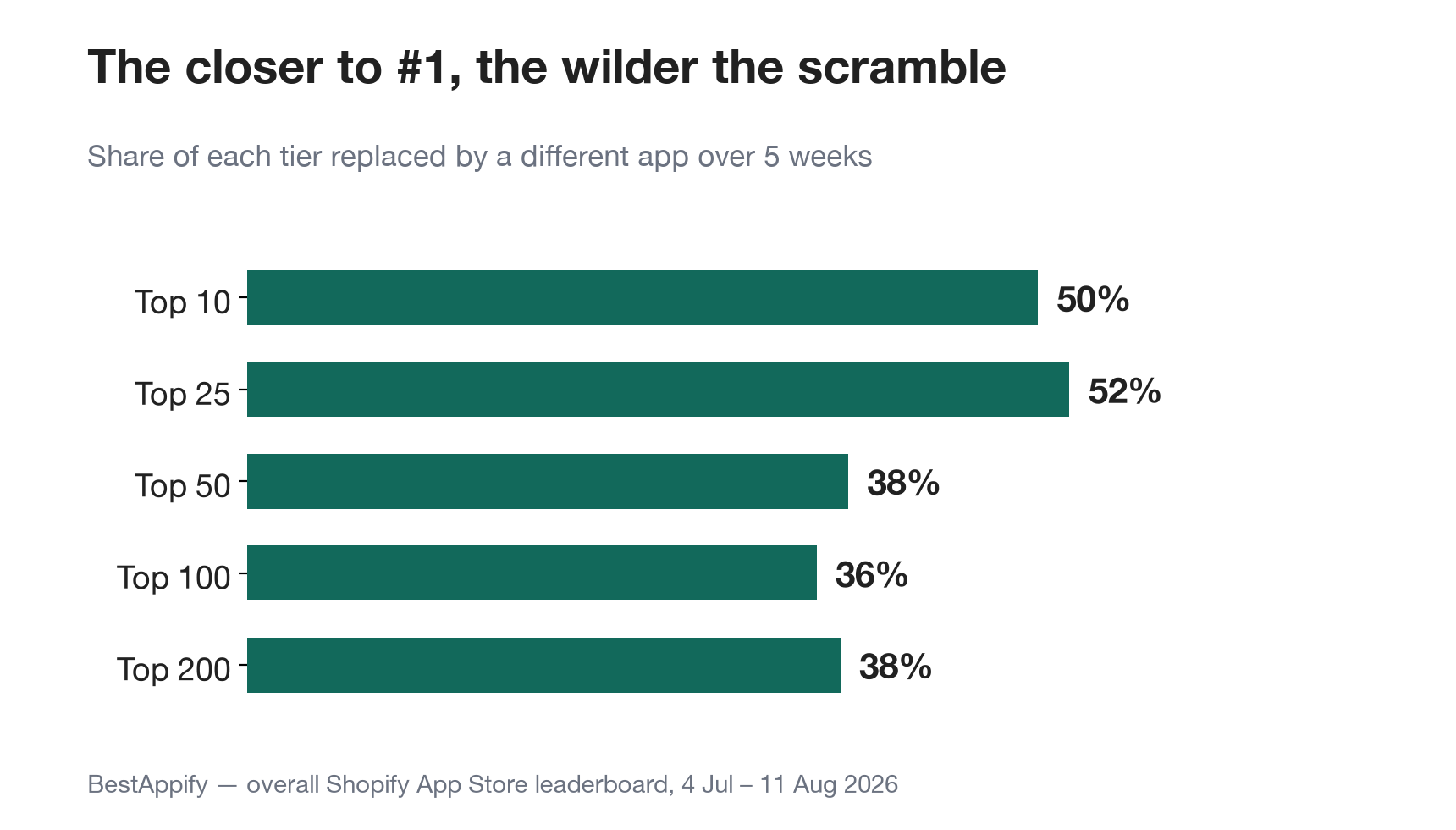
Counter-intuitively, the scramble is fiercest right at the front. The top 50, 100 and 200 were steadier — around 37% turnover — while the podium swapped out more than half its members. The closer to #1, the smaller the review gaps between neighbours, so a single strong month vaults an app past several rivals at once.
Superseded — the turnover figures in this table and the chart above count apps our crawler first discovered mid-window as if they had climbed. See the correction below.
| Tier | Held their tier | Turned over |
|---|---|---|
| Top 10 | 5 of 10 | 50% |
| Top 25 | 12 of 25 | 52% |
| Top 50 | 31 of 50 | 38% |
| Top 100 | 64 of 100 | 36% |
| Top 200 | 125 of 200 | 38% |
Only two apps in the entire top 200 finished on the exact rank they started.
Who's climbing — and why
Movement on a review-count leaderboard has one engine: review velocity. The apps that climb are simply the ones collecting new reviews fastest.
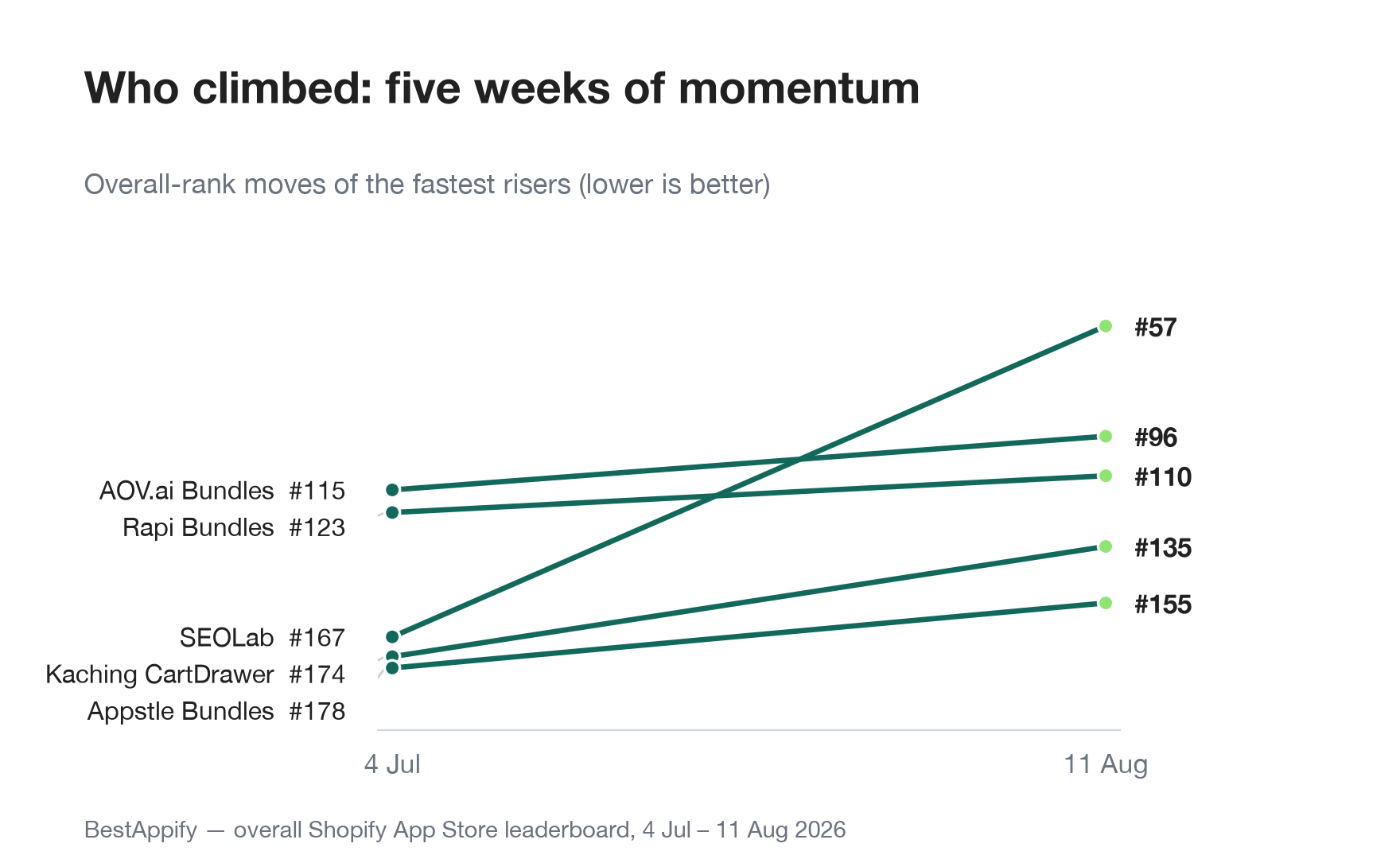
The clearest riser was SEOLab, an AI SEO app that jumped from #167 to #57 as its review count went from 470 to 2,319 — almost five times as many in five weeks. And notice the company it keeps: AOV.ai Bundles, Rapi Bundles, Kaching CartDrawer, Appstle Bundles. Nearly every fast riser is a bundle-and-upsell app. That is not a coincidence — it is a whole category having a moment, and the momentum shows up in the standings before it shows up anywhere else.
The one thing that didn't move
Judge.me. It started at #1 with 33,342 reviews and ended at #1 with 43,157 — nearly 10,000 new reviews in five weeks, more than most apps collect in their entire lifetime. That is exactly why the top spot is effectively uncontested: when the leader is growing faster in absolute terms than anyone beneath it, the gap only widens. The scramble is real, but it happens behind the leader, not for the crown.
What this means for you
- If you're choosing an app: “top 10” is a snapshot, not a permanent seal of quality. An app can ride a wave of new reviews into the top ranks in a matter of weeks, and another can slide as rivals outpace it. Check whether the reviews are recent, not just numerous.
- If you're building one: the standings are winnable. Half of today's top 10 was somewhere else five weeks ago. Review velocity — not age, and as we found earlier, not price — is what moves you up. Every app above you that stops shipping is a seat quietly opening.
You can watch the standings shift for yourself: browse the leaderboard sorted by reviews, or run a free store audit to see where the apps you already use sit — and which faster-growing alternatives are gaining on them.
Methodology: BestAppify snapshots the overall Shopify App Store leaderboard — every live app, ranked by cumulative review count. This study compares 4 July and 11 August 2026 for the 200 apps that were in the overall top 200 on the earlier date and still ranked on the later one. “Turnover” is the share of a tier occupied by a different app at the end of the window. We scope to the top 200 because that band is captured consistently across the five weeks.
Correction, 27 August 2026 — the turnover figures above were our own crawler
The headline of this study was wrong, and the cause was on our side. When it was written, our crawl covered 756 apps in early July and had grown to the full 10,934 listings by mid-August. Comparing a 4 July snapshot with an 11 August one therefore counted every newly discovered app as a new entrant.
Five of the ten apps that appeared to storm the top 10 — TikTok, Shopify Flow, Shop, Pop Convert and DSers — had simply not been crawled yet on 4 July. TikTok carries 15,361 reviews. It did not climb anywhere; we had not met it.
Re-run with the universe frozen at both ends — the same 756 apps ranked against each other on 4 July and again on 25 August, with everything discovered in between discarded — the store looks much steadier:
| Tier | Held their tier | Turned over |
|---|---|---|
| Top 10 | 9 of 10 | 10% |
| Top 25 | 20 of 25 | 20% |
| Top 50 | 48 of 50 | 4% |
| Top 100 | 87 of 100 | 13% |
| Top 200 | 179 of 200 | 11% |
The original claim that the scramble is fiercest at the very front does not survive either. The top 10 is the steadiest tier, not the most volatile: the leaders are separated by thousands of reviews, and gaps that size take longer than a summer to close.
What does survive, and is the more useful finding: almost nothing holds still, and almost nothing moves fast. 195 of the 200 apps changed rank over the seven weeks — only five finished exactly where they started — but the median move was just 14 places, and the 90th percentile 36. Zoom in to 17–25 August, where the catalogue was fully crawled at both ends, and the top 100 did not change at all while 119 of the top 200 held their exact rank.
Review velocity is still the engine, and it runs in both directions. SEOLab climbed from #167 to #37 on the back of 470 reviews becoming 2,354. LimeSpot fell from #155 to #229 while its review count went down, 510 to 391 — review totals are not a ratchet, and the standings notice when they shrink.
The general lesson, for anyone running a study on a dataset that is still growing: a new entrant and a newly discovered record are indistinguishable unless you freeze the population. Rank a fixed cohort at both ends of the window and discard whatever you met in the middle.