
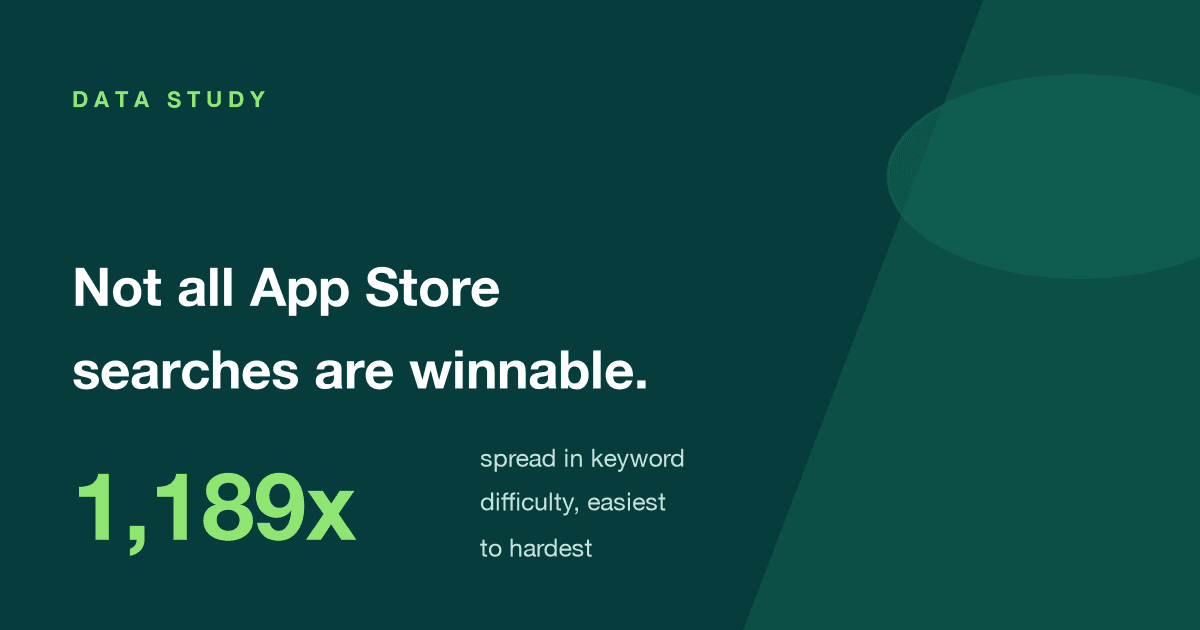
App Store keyword difficulty varies 1,189× — the top 10 for the easiest search share 58 reviews, for the hardest 68,985. Where you compete decides more than how polished your listing is.
Not All Shopify App Store Searches Are Winnable. We Scored 1,210
Every guide to ranking a Shopify app tells you to polish your listing: sharpen the title, rewrite the first two lines, add keywords to the description. That advice isn't wrong. It's just aimed at the wrong decision. The biggest lever on whether you rank is chosen before you write a word of your listing — it's which searches you're competing on at all.
We crawl the App Store's search results every day, so we can put a number on how much that choice matters. It matters enormously: across 1,210 non-brand search terms, the hardest is 1,189× harder than the easiest.
How to measure a search's difficulty
The App Store ranks search results largely by cumulative review count — the apps with the most reviews sit at the top. So a fair proxy for "how hard is it to break into this search" is the combined review count of the ten apps already holding its top 10. If those ten share a few hundred reviews between them, a newcomer can plausibly climb in. If they share tens of thousands, you are not outranking them this quarter no matter how good your copy is.
We computed that for every non-brand term we track, current to 2026-08-18. Brand searches — an app's own name, like "yotpo reviews" — were excluded: nobody competes on a rival's brand, and they would only inflate the hard end.
The spread is the whole story
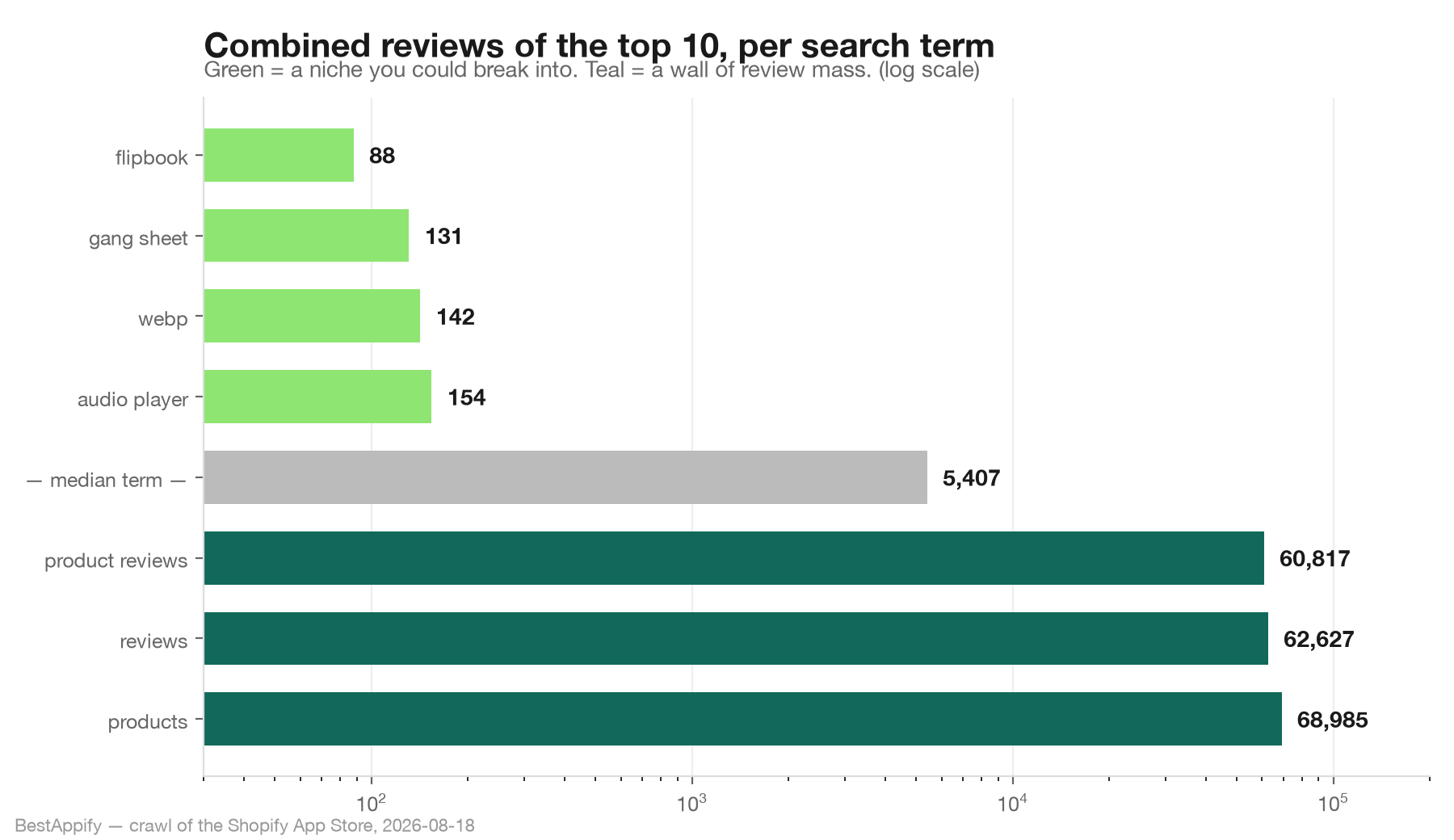
The easiest term's top 10 share just 58 reviews. The hardest share 68,985. The median term sits at 5,407 — meaning half of all searches already have five-figure review mass parked at the top before you arrive.
The extremes make a fun headline, but the number a developer should act on is the typical gap: the 10th-percentile term (an easy one) sits at 1,104 combined reviews, the 90th-percentile (a hard one) at 17,403. That's still a 16× difference between a routinely-easy and a routinely-hard search — the kind of gap that decides months of organic installs.
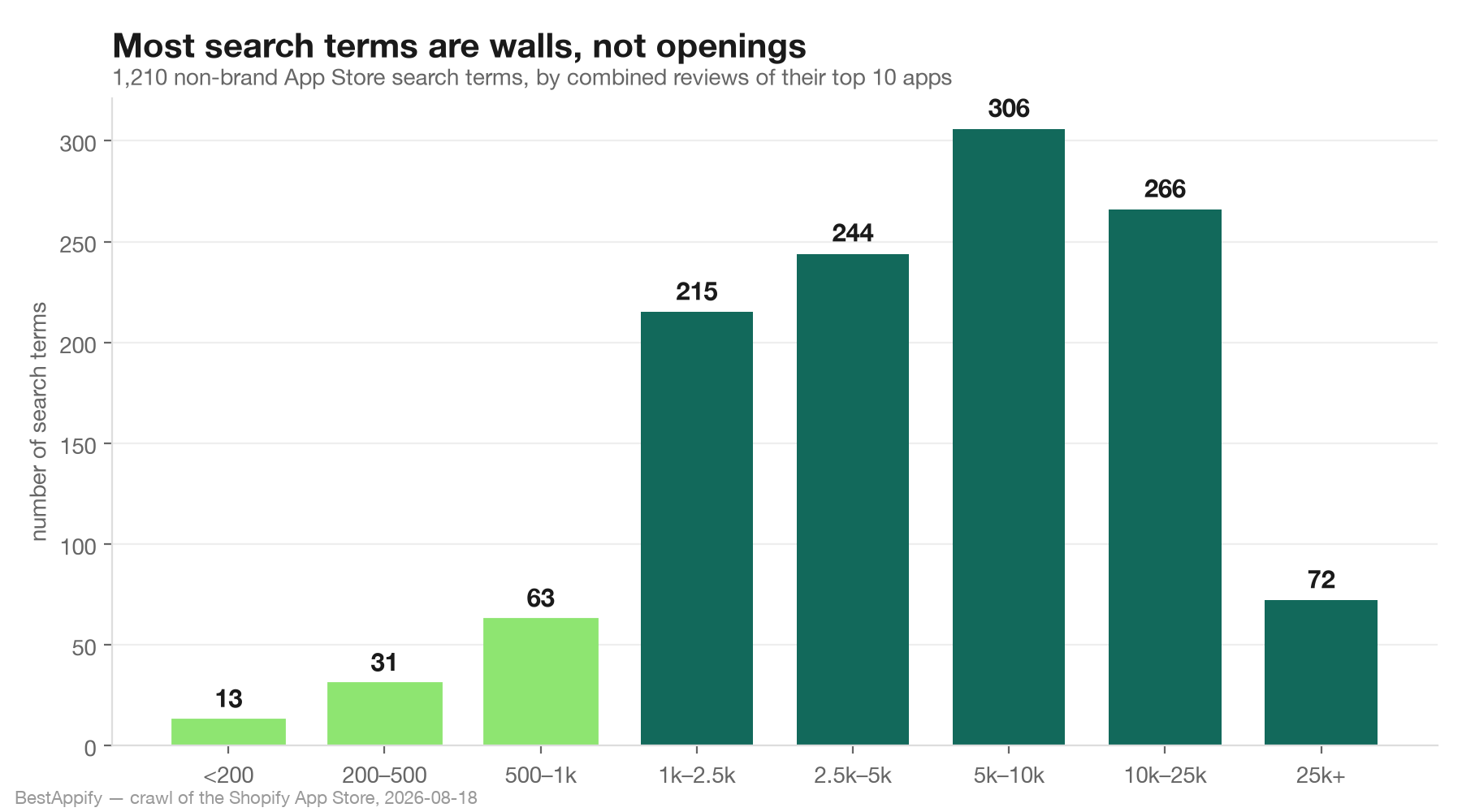
Two things fall out of that shape. First, genuinely winnable searches are rare: just 9% of terms have a top 10 holding fewer than 1,000 combined reviews. Second, the head terms everyone instinctively targets — "reviews", "products", "upsell" — are exactly the 7% that are effectively closed. Chasing them is the most common way an ASO effort quietly produces nothing.
But "easy" is not the same as "worth it"
Here's the honest catch, and it's the part most keyword tools skip. The easiest terms are easy for a reason: barely anyone searches them. "Courierfy", "tradelle", "bosta" — several of the very easiest are near-brand or hyper-niche terms with almost no volume behind them. Ranking #1 for a search nobody types wins you nothing.
So the target isn't the easiest end of the chart. It's the middle-left: terms with real merchant intent — "gang sheet", "flipbook", "webp", "audio player", the specific thing your app actually does — whose top 10 still shares hundreds, not tens of thousands, of reviews. Those exist in every category. They just don't announce themselves, because the store gives you no difficulty signal at all.
What to do with this
- Score a term before you target it. Open its top 10 and add up the review counts. Under ~1,000 combined and the search has real intent? That's a keyword worth putting in your title. Over ~20,000? Cross it off, however tempting the volume looks.
- Stop competing on head terms. "reviews", "products", "email" and their kind are already decided. Your listing copy cannot out-rank 60,000 reviews.
- Win the specific before the general. A cluster of mid-difficulty terms that precisely describe your app will out-install one hopeless push at a category head term — and they compound, because ranking on the specific ones is what eventually earns the reviews you'd need for the hard ones.
Method and limits
Data is our own daily crawl of App Store search results, current to 2026-08-18. Difficulty is the summed review count of the apps in a term's live top 10; we scored the 1,210 non-brand terms where we captured a near-complete top 10. Three honest limits: review count is a proxy for the store's real (undisclosed) ranking formula, so it approximates difficulty rather than measuring it exactly; we exclude brand searches, which are uncompeteable by definition; and difficulty is a snapshot — a term can harden as its incumbents accumulate reviews, though rarely fast.
Want the difficulty score for the searches that matter to your app? BestAppify tracks App Store rankings and keyword competition daily — the free plan covers one app and three keywords.
Update, 24 August 2026 — the dataset has grown
Our keyword crawl has since scored 1,598 non-brand searches, up from the 1,210 this study was written on. The shape of the finding is unchanged, but two things are worth correcting in light of the larger sample.
First, the headline ratio was fragile. Comparing the single easiest term to the single hardest is a ratio of two extremes, and it grows every time the crawl finds a quieter search — on the current data it would read 6,929×, not because the App Store got harder but because we found an easier term. A percentile spread is the number that holds still:
- 10th percentile: the top 10 share 982 reviews
- Median: 5,173
- 90th percentile: 17,160
So the honest version of "some searches are 1,189× harder" is this: a typical hard search is about 17× the wall of a typical easy one, and half of all searches sit above 5,173 reviews. 161 terms (10%) have a top 10 sharing under 1,000 reviews — those are the winnable ones.
Second, the extremes at both ends are mostly brand names our filter did not catch — "shipmagic" at the easy end, "product reviews by shopify" and "shop app" at the hard end. Nobody outside those companies searches the first, and nobody can win the last. Reading the middle of the distribution rather than its tails avoids both traps.