
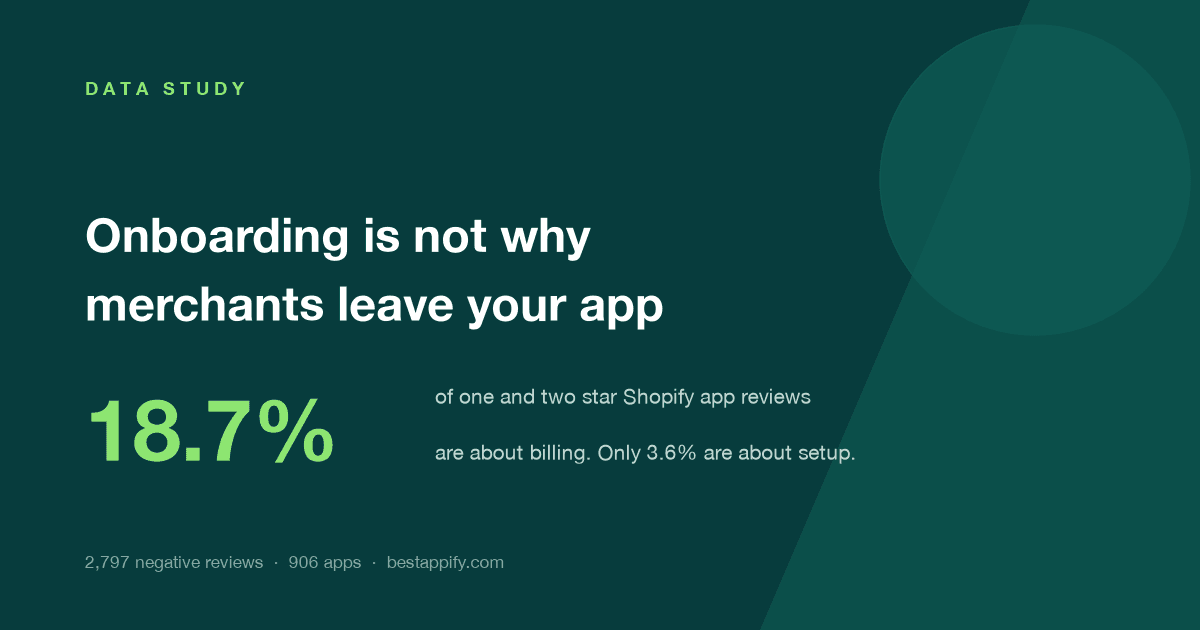
Billing complaints appear in 18.7% of one and two star Shopify app reviews and setup complaints in 3.6%. The median one star reviewer had been paying for 90 days; the median five star reviewer for 30, and a quarter of them wrote within a day of installing.
Onboarding Is Not Why They Leave Your Shopify App. We Read 2,797 Bad Reviews
Ask a room of Shopify app developers why merchants uninstall and you will hear the same answer every time: onboarding. Time to first value. The first ten minutes. Search the Shopify Community forums and the threads are unanimous — merchants leave because setup was confusing and they never saw the point.
We had the reviews on hand to check, so we did. Across 60,278 reviews from 906 apps, the merchants who bothered to explain themselves are overwhelmingly not talking about setup. They are talking about money, and they are leaving after months, not minutes.
Half of the negative reviews that name a reason are about billing
Of the 2,797 one and two star reviews in our sample, 524 mention billing — being charged after uninstalling, a charge they did not expect, a refund they could not get. That is 18.7% of every negative review, and 48.3% of the ones that name a reason at all. Setup and usability comes to 3.6%, or 9.3% of those naming a reason. The thing the ecosystem blames is the fifth most common complaint.
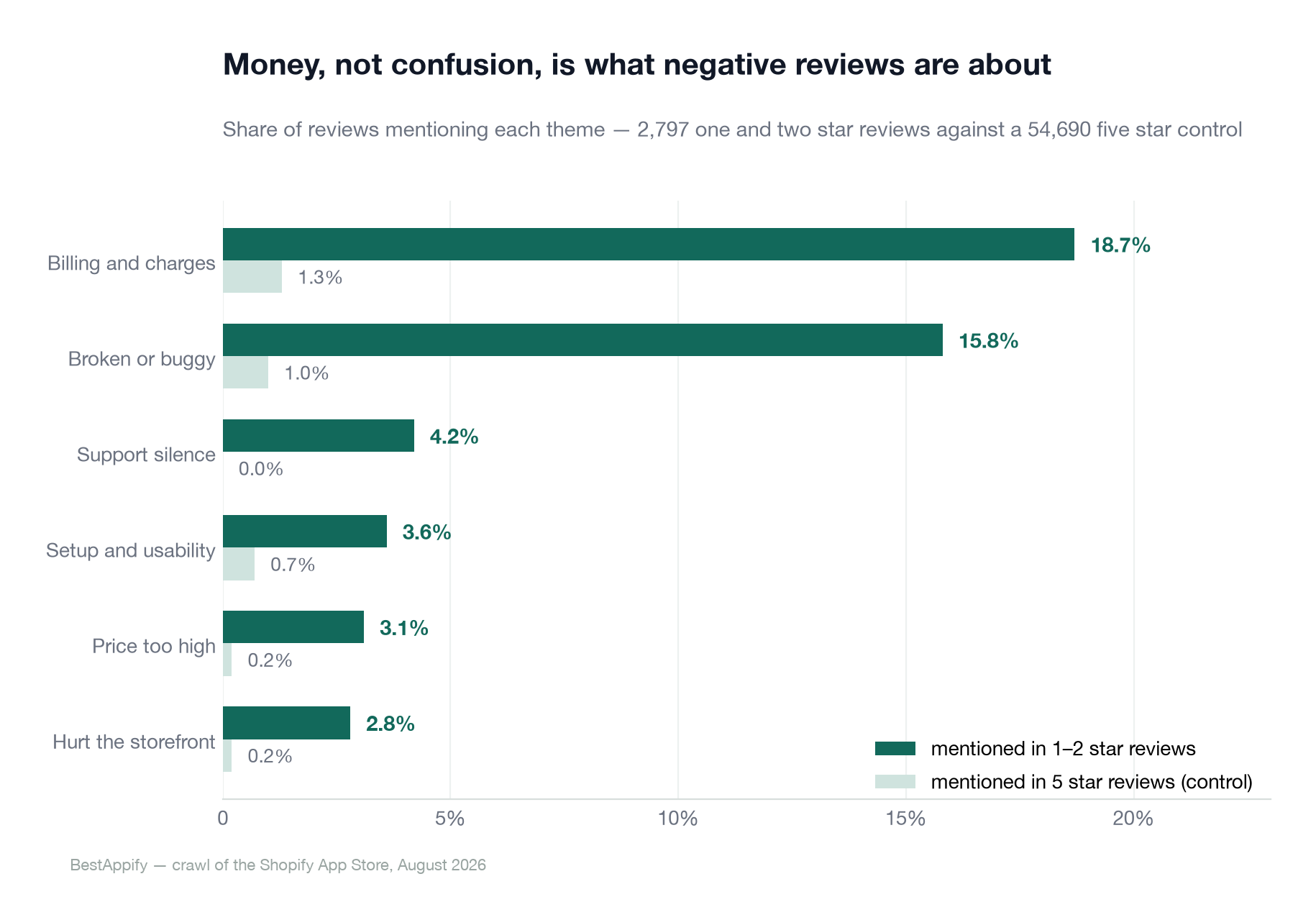
Within those 524 billing complaints, 26.7% are asking for a refund, 12.2% say they were charged after uninstalling or cancelling, and 9.9% use the words scam, fraud or theft. Whatever is happening operationally, a tenth of the merchants complaining about your bill think they were robbed.
The second theme is close behind and equally unglamorous: 15.8% say the app did not work — bugs, errors, features that never fired. Between them, billing and brokenness cover 81% of the negative reviews that give a reason. Everything the growth advice concentrates on divides up what is left.
Bad reviews come from long-tenured users, not confused new ones
Shopify publishes how long each reviewer had the app installed, which lets us ask when the resentment forms. The answer is late. The median five star reviewer had been using the app for 30 days. The median one star reviewer had it for 90 days, and the median two star reviewer for 120.
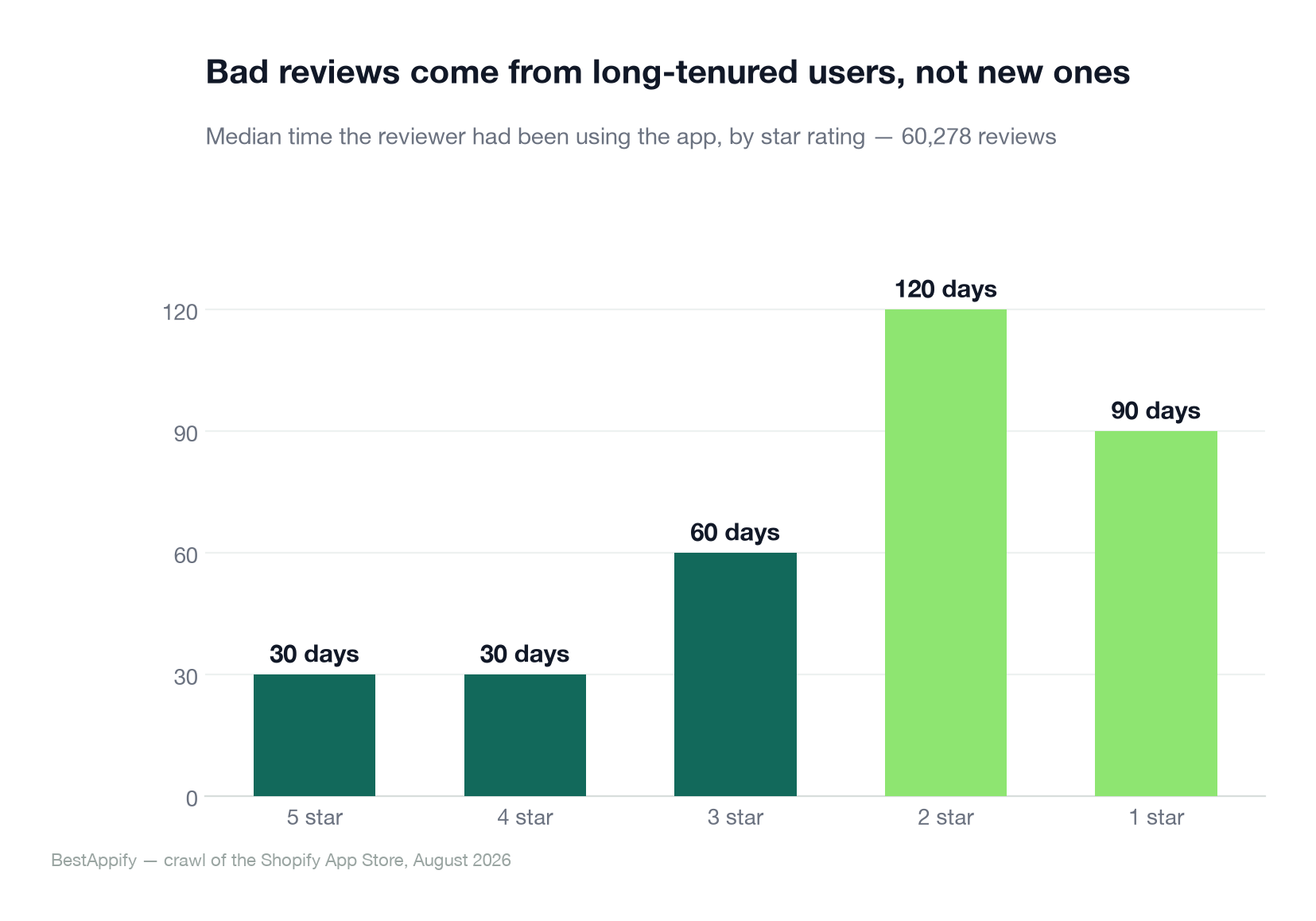
This inverts the standard story. If confusion in the first session were the engine of churn, the angriest reviews would come from the newest users. Instead the newest users are the most positive: 25.7% of all five star reviews are written within a day of install, before the merchant can possibly know whether the app works. A quarter of your social proof is a first impression, and the people who stayed a quarter of a year are the ones writing the warnings.
That fits the billing finding rather than competing with it. A merchant who is confused on day one uninstalls quietly during the free trial and costs nothing. A merchant who has been paying for three months has a bill to be angry about, and by then the trial is long gone.
Developers answer the angry and ignore the happy
One more pattern falls out of the same data. Developers reply to 51.9% of one star reviews but only 27.1% of five star ones.
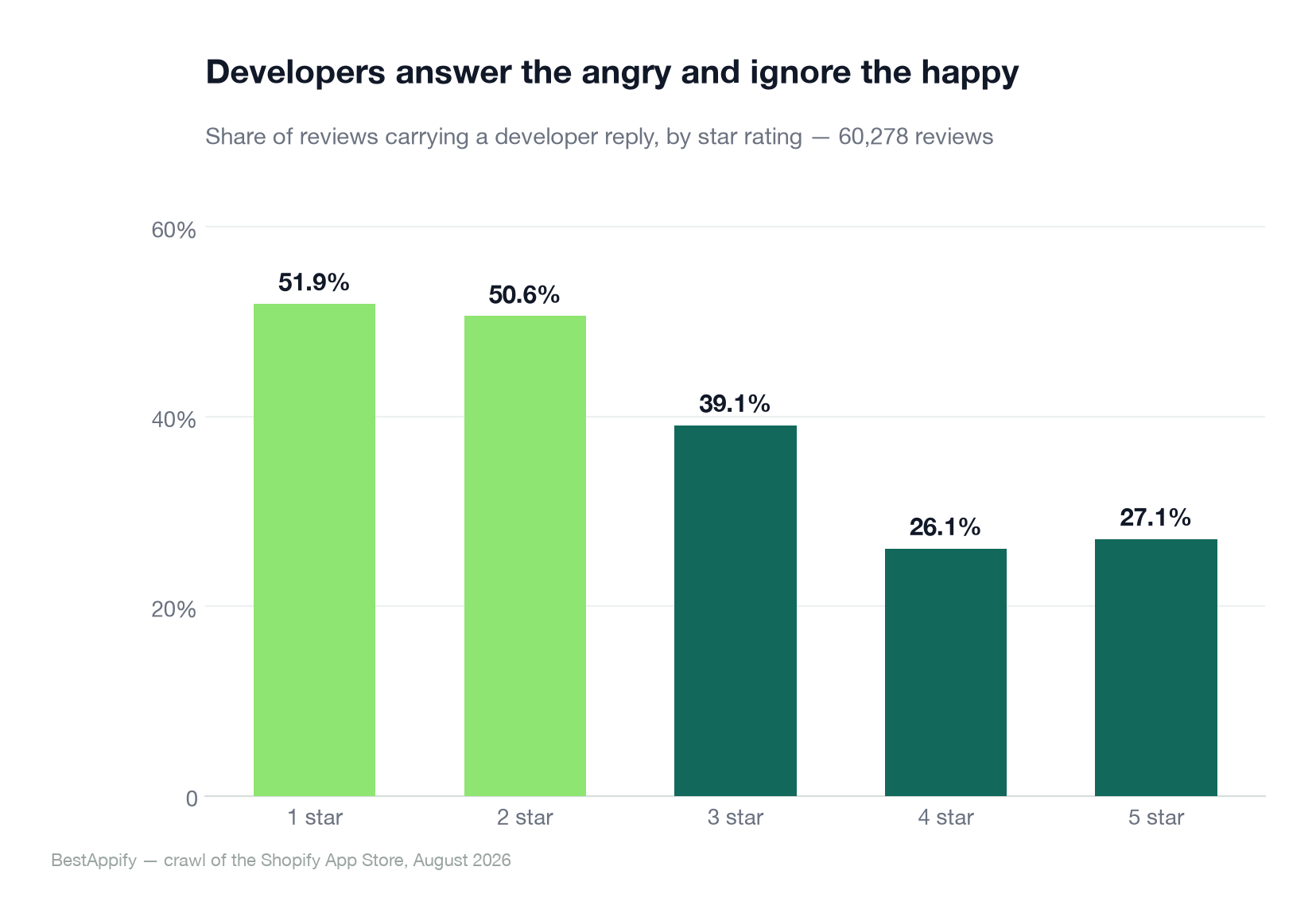
That allocation is understandable and probably wrong. We looked at whether replying moves the needle and found that it does not: replying to reviews does not raise your Shopify app rating. Meanwhile the happy users who could tell you what actually worked — the ones who stayed past 90 days without complaining — are the half of the conversation nobody answers.
What we would do with this
Three things follow, and none of them are onboarding tweaks.
Audit the charge, not the funnel. Look at what happens when a merchant uninstalls mid-cycle, what your app does at a plan boundary, and how a refund request is handled. That is where half of your written complaints are coming from. It is also unusually cheap to fix, because it is policy rather than product.
Stop reading day-one reviews as validation. A five star review written within 24 hours of install is a review of your install flow. It tells you nothing about retention, which means a rising rating can coexist with churn you cannot see. This is on top of the fact that ratings barely separate apps at all — a 4.7 already puts you in the bottom third.
Go and ask the 90-day users something. The tenure data says the verdict forms around month three. Every survey, check-in or exit question you have is probably pointed at week one, which is where the opinions are cheapest.
What this cannot tell you
- Reviews are not uninstalls. A merchant who installs, gets lost and removes the app within the hour almost never writes anything. Silent day-one churn could still be enormous and entirely invisible here — this measures why the merchants who stayed long enough to be angry are angry. If the confusion theory is right, its evidence lives somewhere we cannot see.
- Our sample skews to established apps. 906 apps out of 10,870 live listings, but they carry 84.5% of the store's published reviews. The median app in the sample has 287 reviews; store-wide the median is 1. Nothing here describes apps that nobody has reviewed.
- Themes are keyword mentions, not coded reasons. A human did not read 2,797 reviews and assign a primary cause. 61.2% of negative reviews name no identifiable reason at all (a fifth of them are under 60 characters), 8.2% mention more than one theme, and the shares are of mentions, not of causes. The five star control column is the honest check on that, and it is why we report it beside every theme.
- Tenure is Shopify's own bucket. "Time using the app" is published in coarse bands, so treat 30 versus 90 days as a difference in band, not a precise measurement.
- We hold a slice of each app's reviews, not all of them. Our crawl backfills newest first, so the sample leans recent — 60% of it was posted in 2026. We make no claims about how any of this changed over time.
Method: 60,278 reviews crawled from 906 Shopify App Store listings, alongside a catalogue of 10,870 live apps, as of 25 August 2026. Negative is one or two stars (2,797 reviews); the control group is the 54,690 five star reviews. Themes are case-insensitive keyword patterns applied to review text, reported as the share of reviews mentioning the theme and shown against their rate in five star reviews. Tenure is the "time using the app" figure Shopify publishes with each review. Reply rate is the share of reviews carrying a developer response at crawl time.