
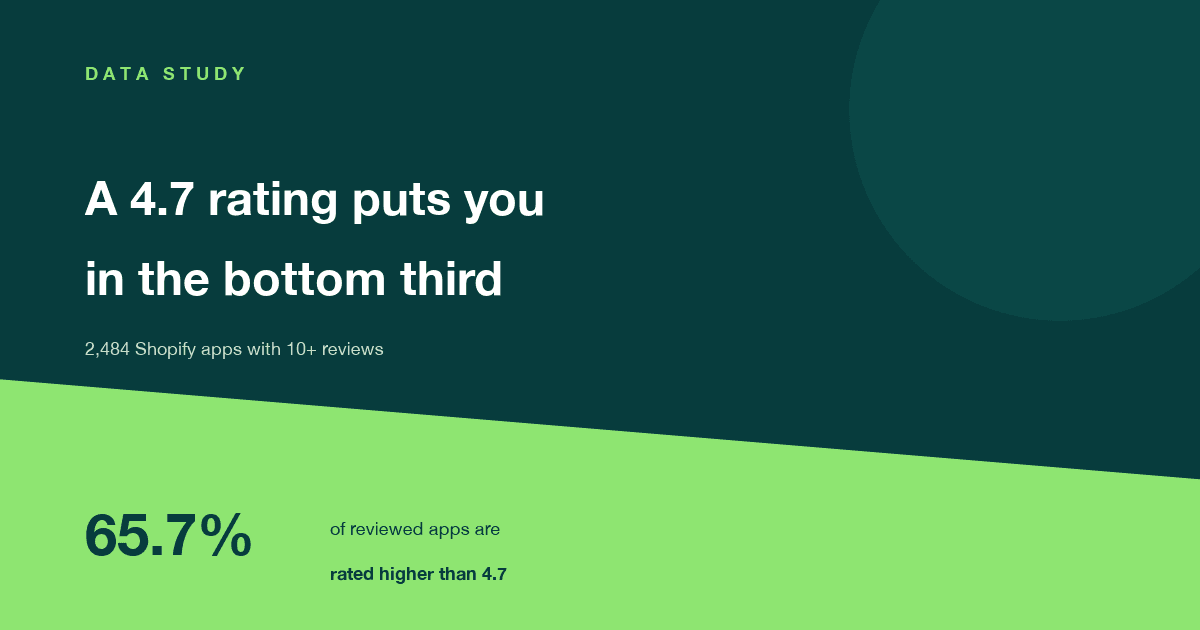
We measured the rating of every Shopify app with at least 10 reviews. The median is 4.90, two thirds sit at 4.8 or higher, and only 6.2% are below 4.0 — so the number that looks healthy on your dashboard is probably below average.
A 4.7 Rating Puts Your Shopify App in the Bottom Third
Open your app's listing, see 4.7 stars, and it reads as a good result. Out of five, it is. Against the rest of the Shopify App Store, it is not.
We took every live app in our crawl with at least 10 reviews — 2,484 of them — and looked at where the ratings actually fall. The median is 4.90. Two thirds are rated 4.8 or higher. A 4.7 is beaten by 65.7% of the store.
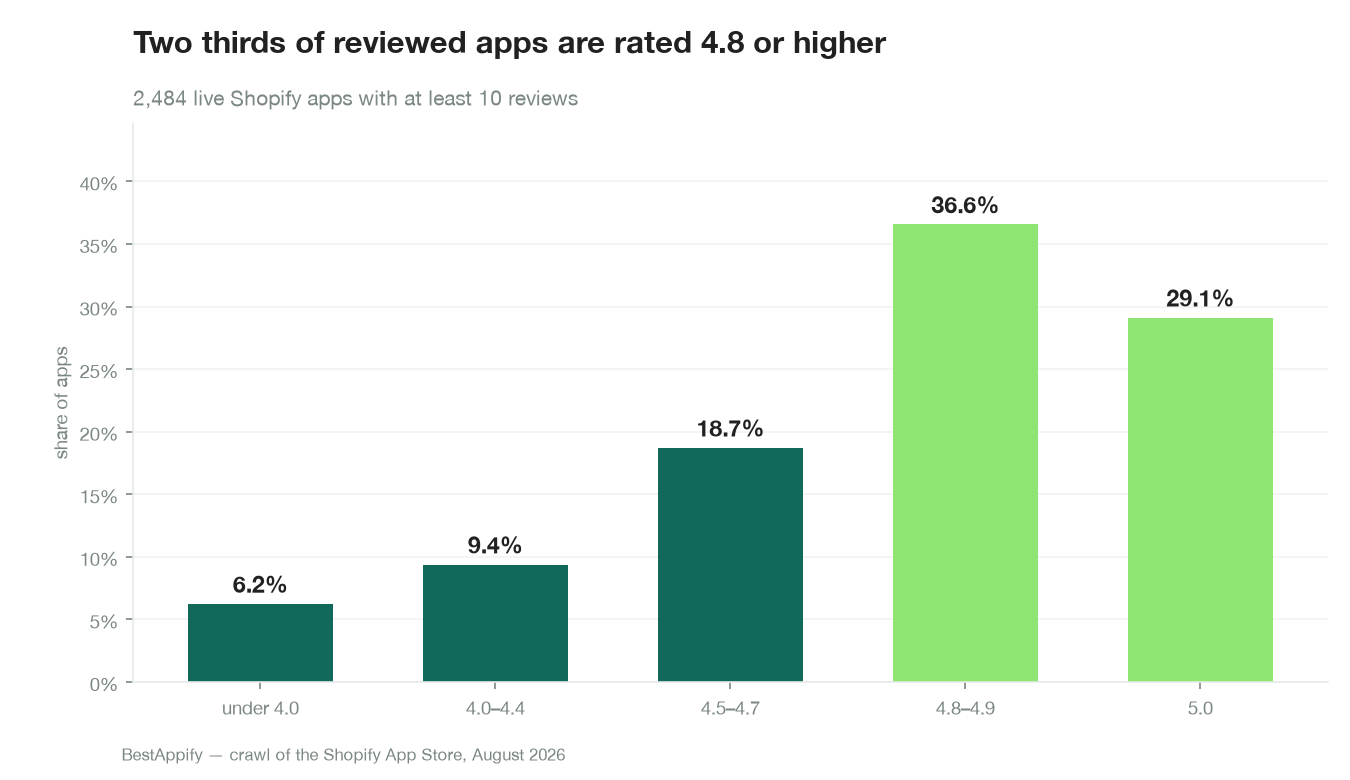
The five-star scale is not really a five-star scale. Almost nothing lives in the bottom half of it: just 6.2% of reviewed apps are rated below 4.0, and 15.6% below 4.5. The working range on this store is roughly 4.4 to 5.0, and inside that narrow band a tenth of a star moves you past hundreds of competitors.
Where your rating actually sits
Find your number and read across. "Beaten by" is the share of reviewed apps rated higher than you.
| Your rating | Beaten by |
|---|---|
| 4.4 | 84.4% |
| 4.5 | 80.6% |
| 4.6 | 74.3% |
| 4.7 | 65.7% |
| 4.8 | 52.1% |
| 4.9 | 29.1% |
| 5.0 | 0% |
The jumps are not evenly spaced. Going from 4.7 to 4.8 overtakes 13.6% of the store. Going from 4.8 to 4.9 overtakes 23.0%. The last tenth of a star is where the crowd is.
The obvious objection: aren't the 5.0s just tiny apps?
This was our first thought too. An app with 11 reviews can hold a perfect score by luck; an app with 11,000 cannot. If the compression is really a small-sample artifact, then average ratings should fall as review counts rise — the usual regression to the mean.
They don't. They go the other way.
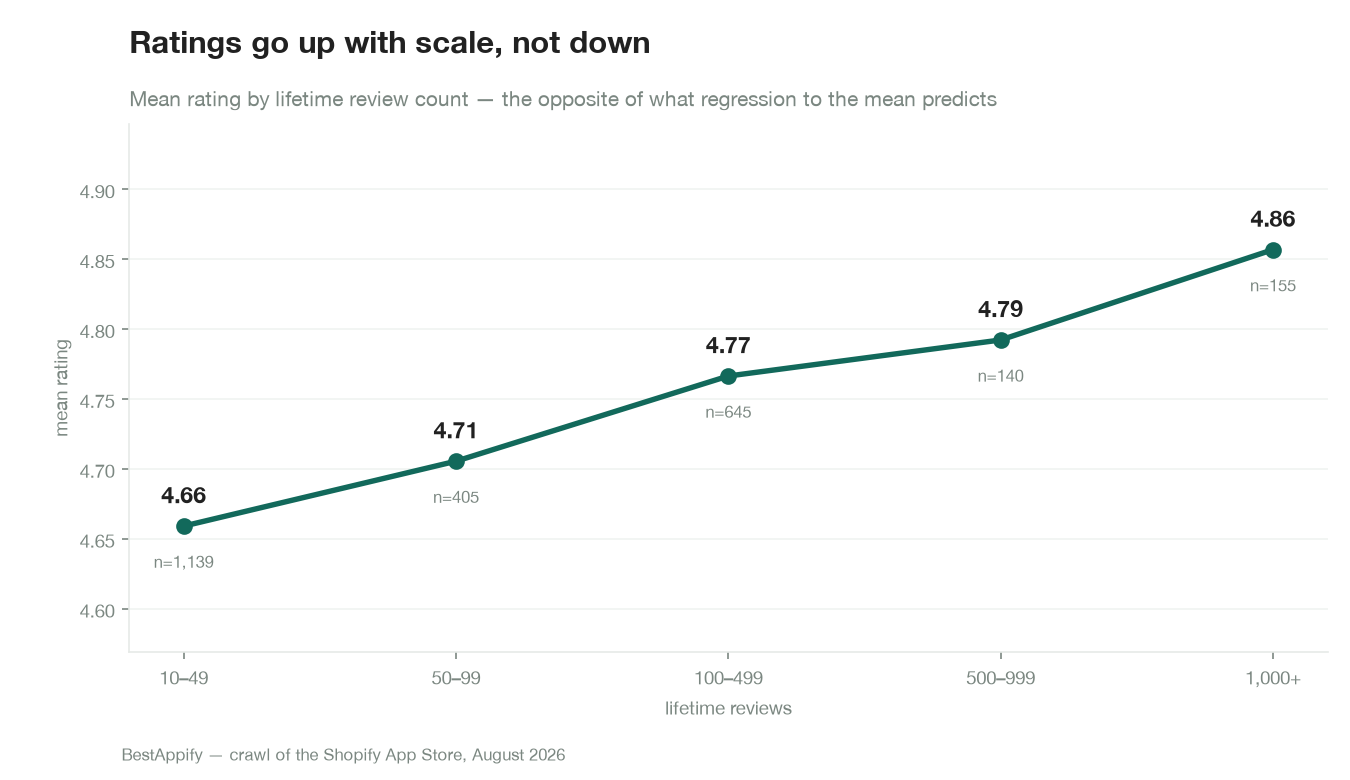
Apps with 10–49 reviews average 4.66. Apps with more than a thousand average 4.86. Every step up in scale is a step up in rating, which is the opposite of what the small-sample explanation predicts.
Perfect scores do behave partly as expected — they are commonest among the smallest apps, where 37.5% sit at exactly 5.0 against 20.2% in the 100–499 band. But the pattern is not a clean decline: the share climbs again to 27.1% among apps with over a thousand reviews.
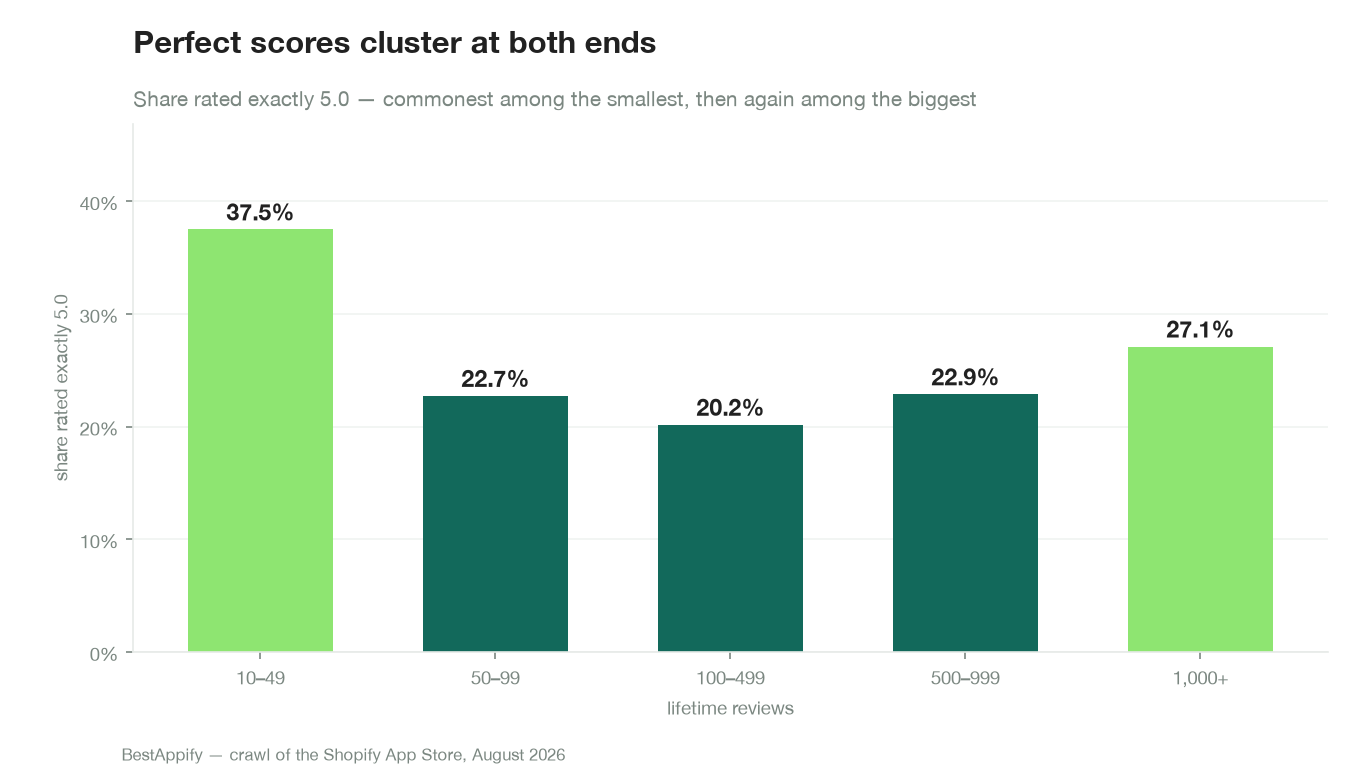
So there are two different populations holding a 5.0: small apps that have not yet met a hard customer, and large apps that are genuinely very good. The dip is in the middle — the awkward stretch where you have enough users to have annoyed some of them, but not yet the polish that comes with scale.
What this means if you build apps
- Treat 4.8 as the pass mark, not 4.0. Below it you are in the bottom half of reviewed apps, whatever the number feels like out of five.
- A rating problem at 4.6 is worth more attention than a feature request. Recovering to 4.8 moves you past a fifth of the store; most features move you past none of it.
- Don't read a competitor's 5.0 as excellence. Check the review count first. At under 50 reviews it is close to meaningless; at over a thousand it is the real thing.
- Scale is not your enemy here. The data says growing your review count has historically come with a higher average, not a lower one.
What this data can and can't say
Three honest limits.
We only counted apps with at least 10 reviews, because a rating built on three is not a rating. That excludes about two thirds of the store — including 3,003 live apps with no reviews at all, who have no rating to be compressed.
The rising average with scale is an association, not a mechanism. Bigger apps may be rated higher because they are better, or because the ones that were badly rated never got big. Our data cannot separate those, and anyone who tells you otherwise from public listing data is guessing.
And the compression itself has a well-known cause we did not measure: happy merchants get asked for a review inside the app, while unhappy ones tend to uninstall without saying anything. The scale you compete on is the top half of one.
Where these numbers come from
Every figure here is computed from our own crawl of the Shopify App Store — 7,610 live apps and 734,152 reviews as of August 2026. No survey, no estimates.
This is one finding from six in our free report, The State of Shopify Apps 2026, which also covers what share of the store has never been reviewed, how concentrated each category is, what the going price actually is, and the table most people screenshot: how many reviews it takes to hold each rank band in the store.