
We compared the entry price and star rating of 642 Shopify apps. The correlation is 0.005 — a $9 app and a $50 app both average 4.87 stars. Here's why price tells you nothing about quality, and what to look at instead.
Do Pricier Shopify Apps Get Better Ratings? We Checked 642
You would expect a $49-a-month Shopify app to be better than a $5 one. Someone is paying nearly ten times as much — surely the reviews reflect it. They don't. Across 642 apps, the correlation between what an app costs and its star rating is 0.005 — statistically indistinguishable from zero.
A $9 app and a $50 app land on the exact same score: 4.87 stars. Here is the full picture, and what actually separates a good app from a mediocre one.
Every price tier scores the same 4.8
We took every live Shopify app with at least 10 ratings and a structured price on its listing — 642 in all — and grouped them by entry price: the cheapest paid plan, or free. Then we averaged the star rating in each group.
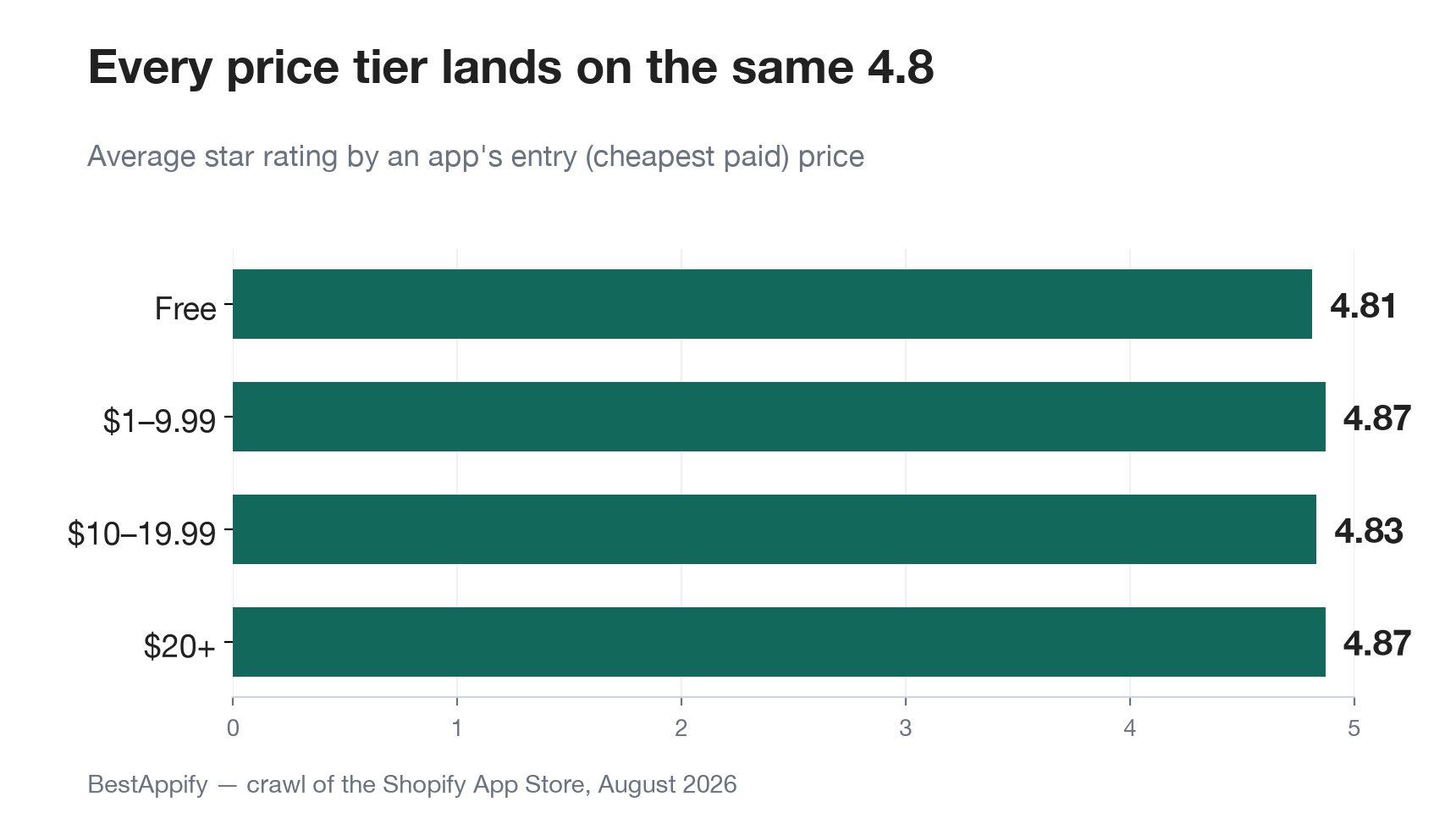
The bars barely move. Free apps average 4.81. Apps that start at $20 or more — some of them $150 a month — average 4.87, the same within rounding as apps under $10.
| Entry price | Apps | Avg. rating | Share rated 4.9+ |
|---|---|---|---|
| Free | 22 | 4.81 | 59% |
| $1–$9.99 | 370 | 4.87 | 70% |
| $10–$19.99 | 154 | 4.83 | 70% |
| $20 and up | 96 | 4.87 | 70% |
Roughly seven in ten paid apps sit at 4.9 or above, no matter what they charge.
The correlation is 0.005
Plot all 620 paid apps as dots — price on one axis, rating on the other — and the trend line is flat.
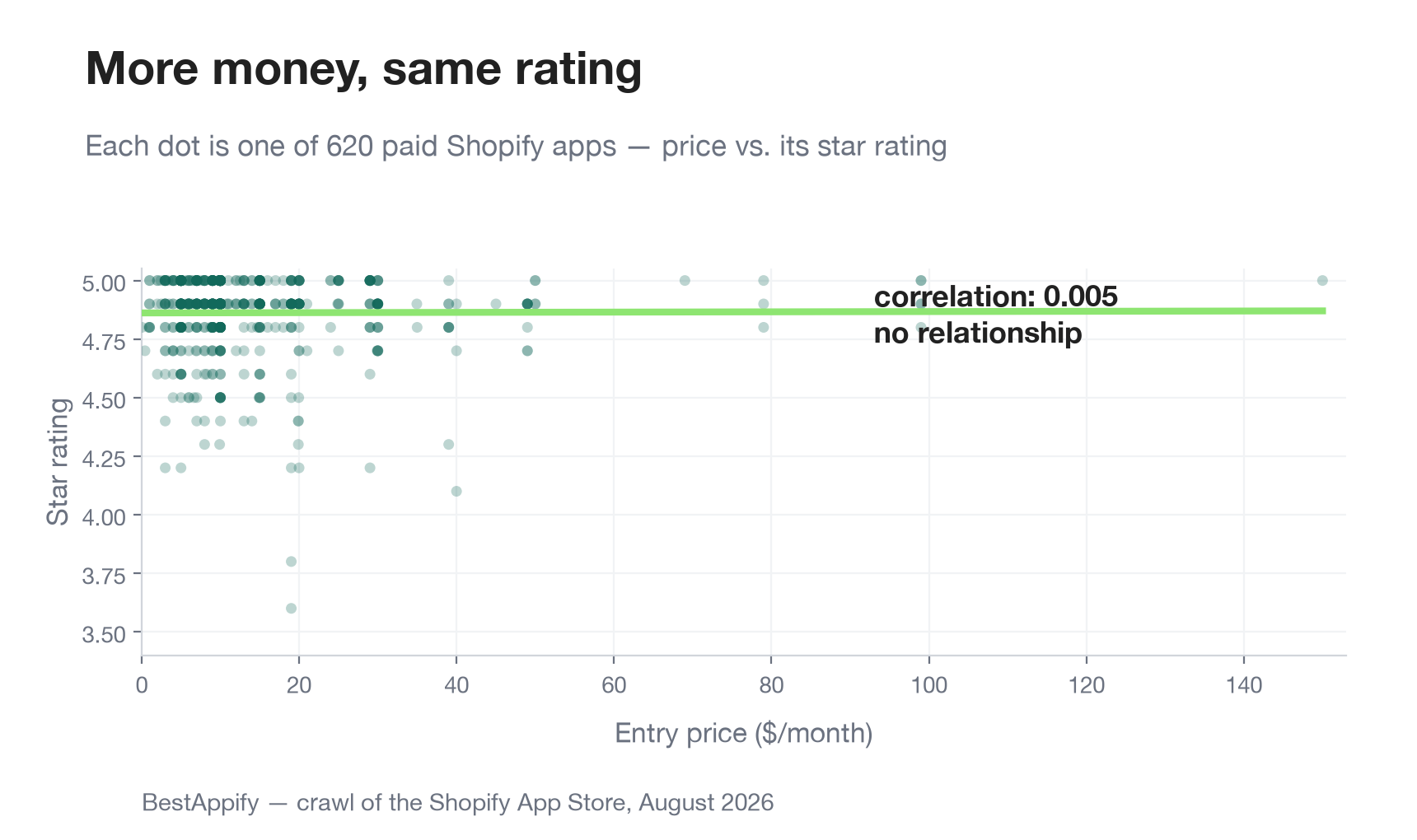
A correlation of 0.005 means price explains essentially none of the variation in rating. Knowing an app costs $50 instead of $5 tells you nothing about whether its users are happier.
Why price can't predict rating
The reason isn't that expensive apps are secretly bad. It's that star ratings barely vary at all. When we looked at ratings across the whole store, nearly half of reviewed apps carried a flawless 5.0, and the median rated app had only a handful of reviews. When almost everything is crammed between 4.8 and 5.0, there is no spread left for price — or anything else — to track.
Price is compressed too. The median entry price across these apps is $9.99, and most apps cluster in a narrow $5–$20 band. Two flat distributions cannot correlate: there simply isn't enough variation on either side to line up.
So what should you look at instead?
If neither the price nor the star rating separates a good app from a forgettable one, lean on the signals that actually carry information:
- Review count, not the star. A 4.8 with 2,000 reviews has been stress-tested by real stores; a 5.0 with three reviews has not. Weight the number of reviews far more heavily than the last decimal of the score.
- How recent those reviews are. A wall of five-star reviews that stops 18 months ago is a warning, not a reassurance — it usually means the developer stopped shipping.
- Fit over price. The cheapest plan that does what your store needs is almost always the right one. You are not buying quality by paying more — the data is unambiguous on that.
The fastest way to put this into practice: browse the app catalogue sorted by review volume rather than stars, so the apps thousands of stores actually rely on rise to the top. Or, if you would rather start from your own store than a list, our free store audit looks at the apps you already run, flags anything you are overpaying for, and shows what comparable stores in your niche use instead.
Methodology: 642 live Shopify apps with at least 10 ratings and a structured price plan on their listing, crawled August 2026. Entry price is the cheapest paid monthly plan, with annual plans converted to a monthly figure; “free” means no paid plan. The correlation is Pearson's r between entry price and star rating across the 620 paid apps.