
1,503 listing changes with a before-and-after, over five weeks: only 3.0% of live listings changed anything, the app name is the most edited field, and 72% of price moves were 50% or larger.
Almost Nobody Touches Their Shopify App Listing. We Watched 1,503 Edits
We fetch every listing in the Shopify App Store and keep the previous version of each field, so when a developer renames their app, rewrites the tagline or moves a price, we see it the next day. This is what five weeks of that looked like: 1,503 changes with a genuine before-and-after, between 6 August and 10 September 2026.
The first number is the one that surprised us. Those 1,503 edits came from 906 listings, and 750 of them are still live — 3.0% of the 24,592 live listings we track. Ninety-seven percent of the store left its shop window exactly as it was for five weeks.
What gets changed
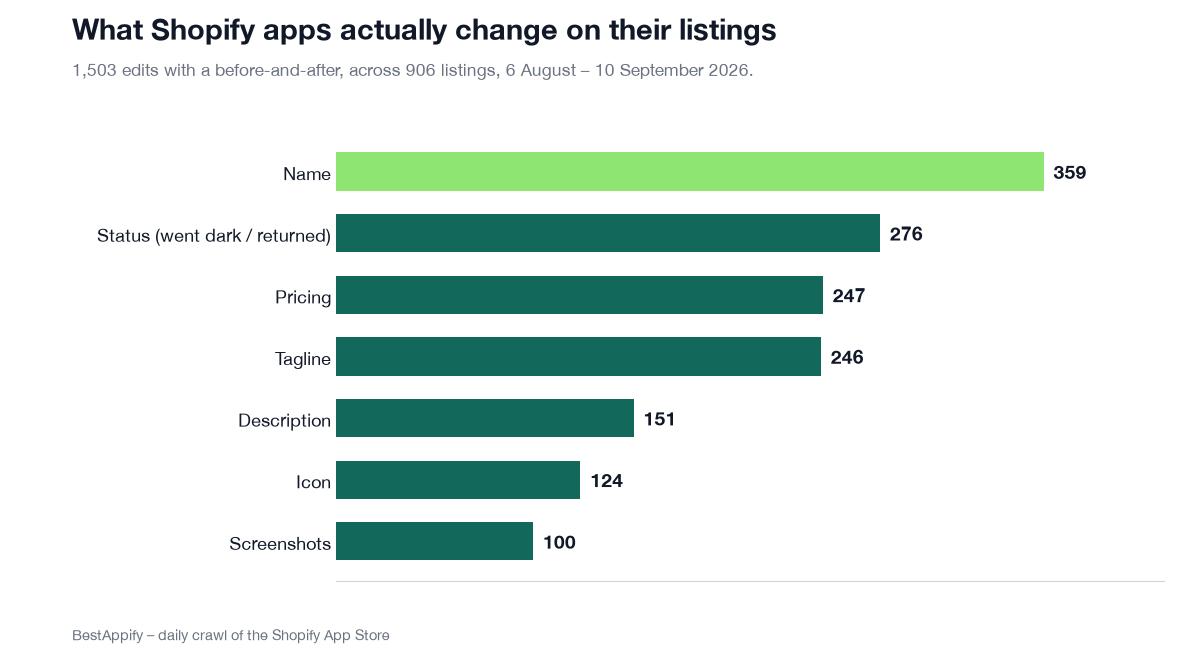
The app name is the most edited field in the store — more than the tagline, more than the description, more than the price. That is worth sitting with, because the name is also the field doing the most work in search: it is the line a merchant reads first and the one the App Store weighs most heavily.
But the renames are lateral. Across 359 of them the median length change is zero characters, and only 42% came out longer. Developers are not stuffing more in; they are reshuffling what is already there:
- FBP | Fast Bundle Product → FBP | Fast Bundle & Upsell App (3,030 reviews)
- Avada Order Limits Quantity → Avada B2B Order Limits (269 reviews)
- MultiVariants ‑ Bulk Order → MultiVariants ‑ Bulk Order B2B (338 reviews)
Two of those three bought the same word: B2B. A rename is the cheapest repositioning available to an app, and it is being spent on chasing a buyer, not on describing the product better.
Nobody nudges a price
247 pricing edits landed in the window. Strip out the ones that rewrote plan names without moving the entry price, and the placeholder $0.01 tiers that some developers park on a plan, and 114 are real moves in the cheapest paid plan: 55 increases and 59 cuts. An almost even split, which is the boring part. The interesting part is the size.
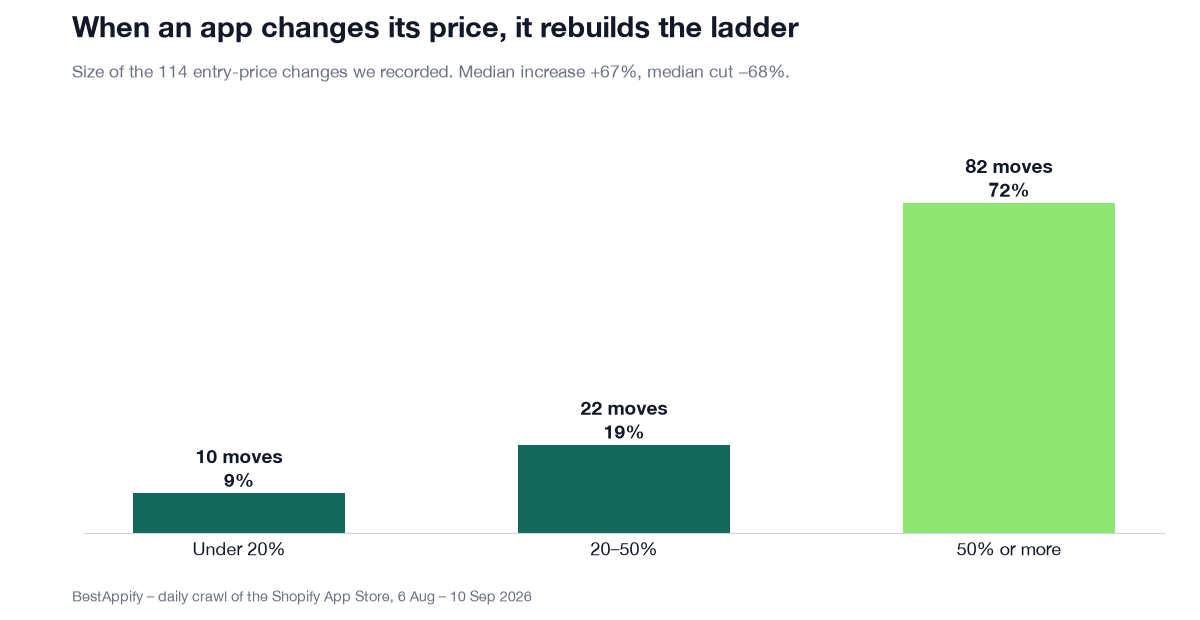
72% of price moves were 50% or more. Only 9% were under 20%. The median increase was +67% (about $5 on the entry plan) and the median cut was −68% (about $8). These are not price rises. They are ladders being rebuilt — a plan deleted, a tier renamed, the cheap end pulled out or pushed in.
Among apps with real traction:
- WhatFlow: Whatsapp Automation, 328 reviews — $4.99 → $49.99
- Amp Slide Cart Upsell Drawer, 702 reviews — $14.99 → $29.99
- Preorder Now Presale Timesact, 1,961 reviews — $1 → $5
- Discounty: Bulk Discount Sales, 1,210 reviews — $9.90 → $1.99
- Outlink External Links Button, 143 reviews — $25 → $2.99
The free tier moved too, and in one direction: 31 apps added a free plan, 14 removed one. It matches what we found when we measured whether repricing moves anything — the lineup is the lever, not the number on it.
The bigger the app, the more it edits
We expected the opposite. Established apps have more to lose from touching a listing that works, and the store's long tail is full of listings that look abandoned. The rate says otherwise:
| Reviews | Live listings | Edited something | Rate |
|---|---|---|---|
| None | 14,709 | 162 | 1.1% |
| 1–10 | 6,143 | 220 | 3.6% |
| 11–100 | 2,596 | 182 | 7.0% |
| 101–1,000 | 983 | 153 | 15.6% |
| 1,000+ | 161 | 33 | 20.5% |
An app with over a thousand reviews is nearly twenty times more likely to have changed its listing in these five weeks than one with no reviews at all. Read the raw counts instead of the rates and you would conclude the opposite — 162 unrated apps edited something against only 33 of the biggest — which is what makes this the sort of number worth dividing before quoting.
The causation is not ours to claim from this data. But the correlation is hard to miss: the listings that are maintained are the listings that are winning, and most of the store has never been reviewed at all.
170 listings went dark
The status field is its own story. In five weeks we recorded 170 listings going from live to unreachable, 70 moving from unreachable to formally delisted, and — the part worth knowing before you read too much into any of it — 26 coming back, plus 10 returning from delisted.
So "missing" is a signal, not a death certificate. Roughly one listing in every 145 we track dropped out of the store during the window, and about one in six of those reappeared. If you are tracking a competitor and it disappears, wait a week before writing the post-mortem.
What we would take from this
- Your listing is not a set-and-forget asset, and almost everyone treats it like one. 97% of the store changed nothing in five weeks. That is the competitive context for any edit you make.
- If you are going to move a price, move it properly. The market's revealed behaviour is that price changes are structural — a tier added, a floor removed — not a few dollars either way. A 10% rise is the one change nobody in this dataset bothered to make.
- Spend the rename on the buyer, not on the feature. The renames that stood out added a market ("B2B"), not an adjective.
- Watch what your competitors change, not just where they rank. A pricing edit or a repositioned name is a decision someone made deliberately, and it shows up in the listing days before it shows up anywhere else.
Method and limits
We crawl the App Store daily and store each listing's fields. A change is only counted when we hold a genuine previous value for that field — first sightings are excluded, which is why a growing catalogue does not inflate the count. The window is 6 August to 10 September 2026, and the denominators are the 24,592 listings that were live when we measured.
Four limits worth stating. Entry price is parsed from the published plan summary, so an app that charges by usage or commission has no entry price here and is excluded from the pricing figures; we also drop baselines under $1, because a $0.01 placeholder tier turns a routine change into a 99,800% increase. "Unreachable" means our crawler could not fetch the listing, which is not the same as Shopify removing it — hence the 26 that came back. Edit rates are per listing, not per developer, so a studio updating twelve apps in a week counts twelve times. And five weeks is a short window: it is long enough to describe behaviour, not long enough to call a trend.