
We measured 40 isolated pricing edits against a control of 8,434 app-dates. Changing the price alone moved rank a mean of -0.08 positions. Changing which plans you offer moved it +0.92 - and of 22 apps that did it, twelve rose and none fell.
Repricing Your Shopify App Does Nothing. Changing Your Plan Lineup Does
Ask a Shopify app developer what they'd change to rank better and pricing comes up fast — usually as a number. Undercut the leader. Drop to $9. Run a sale. It feels like the most direct lever you have, because it's the one you can change in a minute.
We crawl the App Store's search results and its listing pages every day, which means we can watch what happened to an app's rank in the weeks after it edited its pricing. We looked at every pricing edit we logged in the last 120 days. The number on the plan turns out not to matter at all. What plans you offer does.
How we measured it
Our crawl records a listing's pricing as a canonical line — every plan and its price, in order — and logs an event whenever that line changes. For each of those events we compared the app's search position before and after: for every keyword the app ranked on, the last position we recorded before the edit against the first we recorded at least a day after it.
Three things make that comparison honest rather than flattering:
- Only keywords present on both sides count. If an app enters a new search at #38 after the edit, that isn't a decline — but averaging over a changing set of keywords would record it as one.
- Only isolated edits count. Apps very often rewrite the title, tagline and pricing in a single sitting. Every one of those fields then carries the same rank movement, and none of them can be credited with it. We kept only edits where pricing was the sole thing that changed that day.
- There's a control group. We ran the identical measurement on 8,434 app-date pairs where the app changed nothing at all, anchored on the same dates. If the market drifts, the control drifts with it.
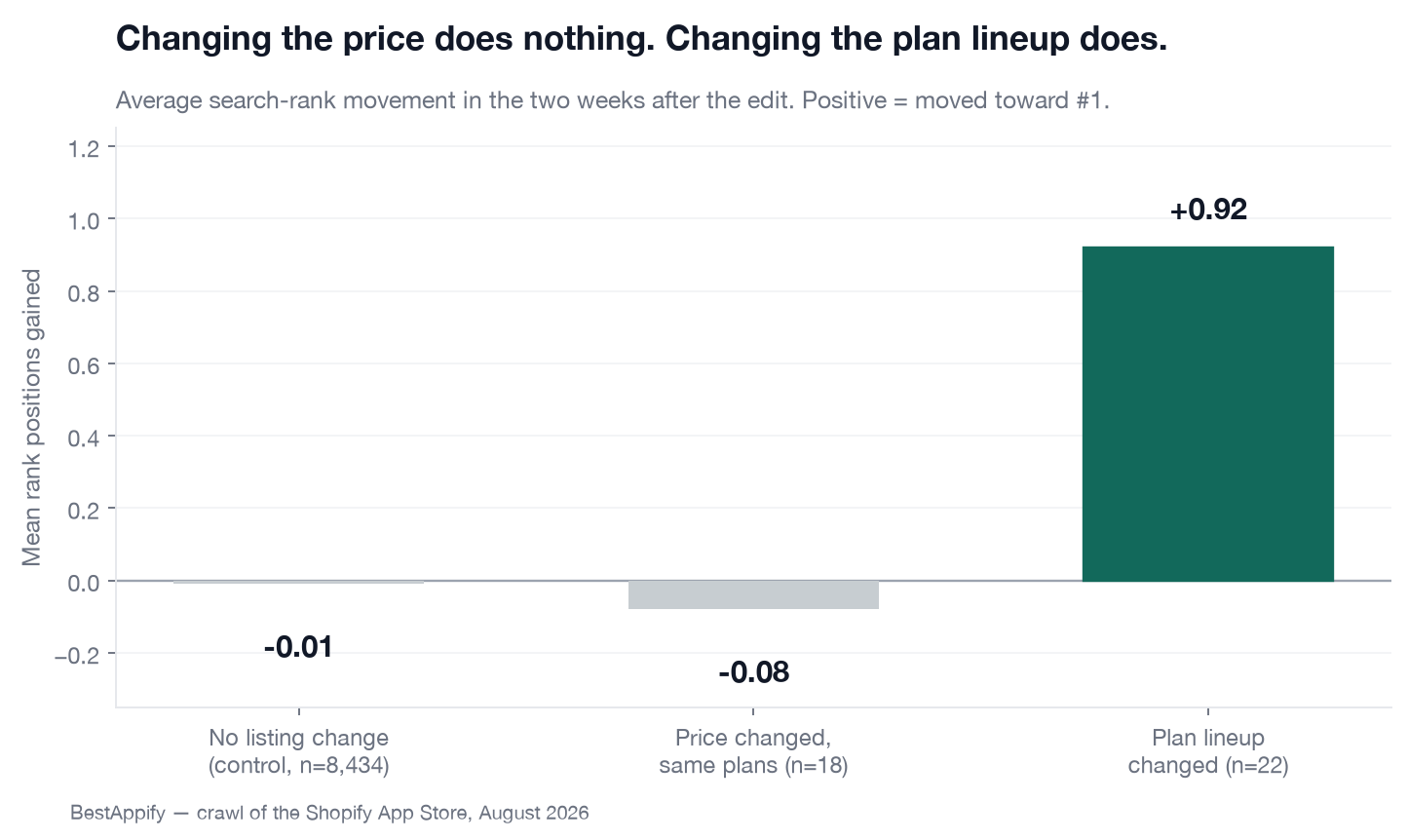
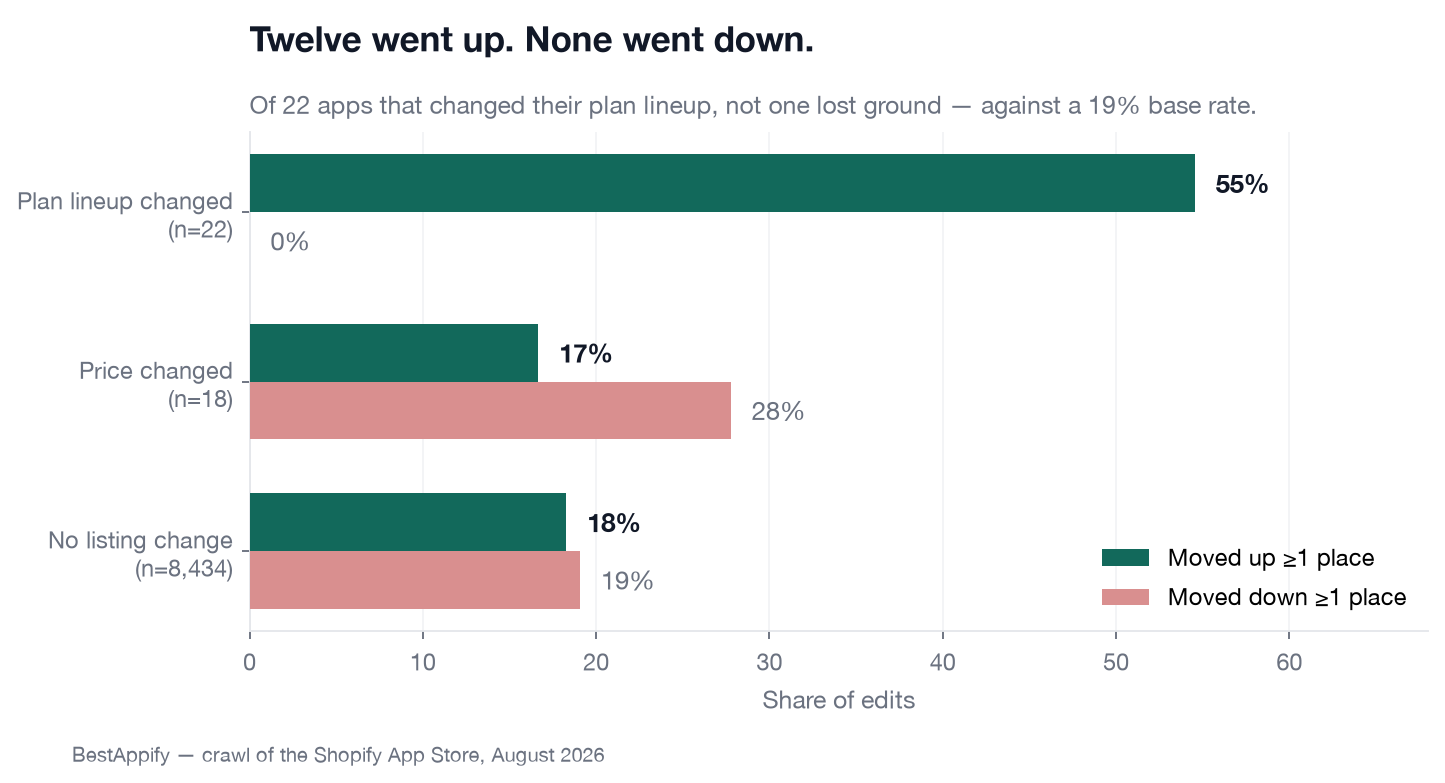
That control is worth pausing on, because it's what makes the rest of the numbers readable. Apps that changed nothing moved a mean of −0.01 positions, a median of exactly zero, with 18.3% rising and 19.1% falling. That is what noise looks like: perfectly balanced, centred on nothing.
Changing the price does nothing
Forty pricing edits survived the filters. We split them by what actually changed. In eighteen of them the plan lineup stayed identical and only the price moved — a $19 plan became $24, a $9 plan became $7.
Those eighteen moved a mean of −0.08 positions. Three rose, five fell. Against the control, that difference is nothing at all (t = −0.26). If you repriced your app hoping search would notice, our data says it didn't.
Changing the lineup does
The other twenty-two edits changed the shape of the plan list rather than a number: adding a tier, removing one, restructuring the ladder. Those moved a mean of +0.92 positions, with a median of exactly one full place.
The direction is the part that's hard to dismiss. Twelve of the twenty-two rose by at least a position. None fell. In the control group, movers split almost exactly evenly between up and down — so getting twelve out of twelve in one direction has a probability of roughly 0.0005 by chance, and drawing 22 apps with none of them declining, against a 19% base rate, comes out around 0.009.
The individual moves point the same way. EventEngage added a free tier beneath a $6.95 plan and gained 4.4 positions. Google Reviews by Reputon added a free development-store tier and gained 2.5. Mage slotted a $15 "Essential" plan below a lineup that started at $49 and gained 1.75. Store Seek went the other way — it removed its free plan — and gained 3.5. What these have in common isn't a direction of price. It's that the set of options changed.
What we think is happening, and what we can't prove
The obvious mechanism is that the App Store treats pricing structure as an attribute of the listing and the price itself as a detail inside it. Merchants filter and browse by whether an app has a free plan or a trial; they don't filter by whether it costs $19 or $24. An edit that changes which of those buckets you fall into is a different kind of event from an edit that changes a number.
We can measure the correlation. We cannot measure the mechanism, and we'd rather say so than dress up a plausible story as a finding. Three limits worth carrying with the number:
- Twenty-two is a small sample. The direction is strong enough to survive it — twelve-nil is hard to get by accident — but the size of the effect is not pinned down. Treat "about one position" as an order of magnitude, not a forecast.
- This is correlational. An app that adds a free tier may well be doing other things at the same time we can't see: a launch push, an ad campaign, an outreach run. We can rule out other listing edits, and we do. We can't rule out the rest of a company's quarter.
- One position is one position. Nothing here turns #30 into #3. It is a real, measurable, small effect, and it is the only listing edit we've measured that reliably produces one at all.
The practical read
If you're deciding where to spend an afternoon on your listing, the pricing number is not where the search return is. Price it for your business.
The plan lineup is a different question, and it's worth asking deliberately: is there a tier that doesn't exist yet — a free plan, a development-store plan, an entry rung under a ladder that starts too high — that would change which merchants can consider you at all? Every app in our data that answered yes and shipped it moved up, or at worst stayed put.
And a note for anyone who wants to check this on their own app: the effect is small enough that you cannot see it by looking at your rank the week before and the week after. You need a control group. Ours said zero, which is the only reason the other numbers mean anything.
Method: 871 listing changes logged across the Shopify App Store catalogue over 120 days, of which 384 were measurable against our daily rank crawl. 46 were pricing edits made on their own; 6 of those turned out to be artefacts of our own crawl recording a plan row twice, and were excluded, leaving 40. Rank movement is measured per keyword on the keywords an app held on both sides of the edit, against a control of 8,434 app-date pairs with no listing change.