
Ranking data from 1,781 Shopify App Store keywords: how many reviews the top 10 really hold at each difficulty level, and which keywords a new app can still win.
Shopify App Store Optimization: What It Actually Takes to Rank
Most Shopify App Store optimization advice is the same six bullet points: put keywords in your title, write a good description, get reviews, pick the right category. All true. None of it tells you the thing you actually need to know, which is whether the keyword you are chasing is winnable at all.
So we measured it. We track daily search rankings for 1,781 non-branded keywords in the Shopify App Store — who ranks, in what position, with what rating and how many reviews. This is what the data says it takes to break into the top 10.
The single number that decides everything: reviews
We score each keyword for difficulty on a 0–100 scale built from the strength of the apps already ranking for it. When you group keywords by that score and look at what the incumbent top 10 actually hold, the pattern is not subtle:
| Keyword difficulty | Keywords | Median reviews held by the top 10 (combined) | Median rating of the top 10 |
|---|---|---|---|
| 0–19 (easy) | 210 | 189 | 4.82 |
| 20–39 | 369 | 1,437 | 4.82 |
| 40–59 | 638 | 3,812 | 4.84 |
| 60–79 | 457 | 9,052 | 4.88 |
| 80–100 (brutal) | 66 | 16,613 | 4.90 |
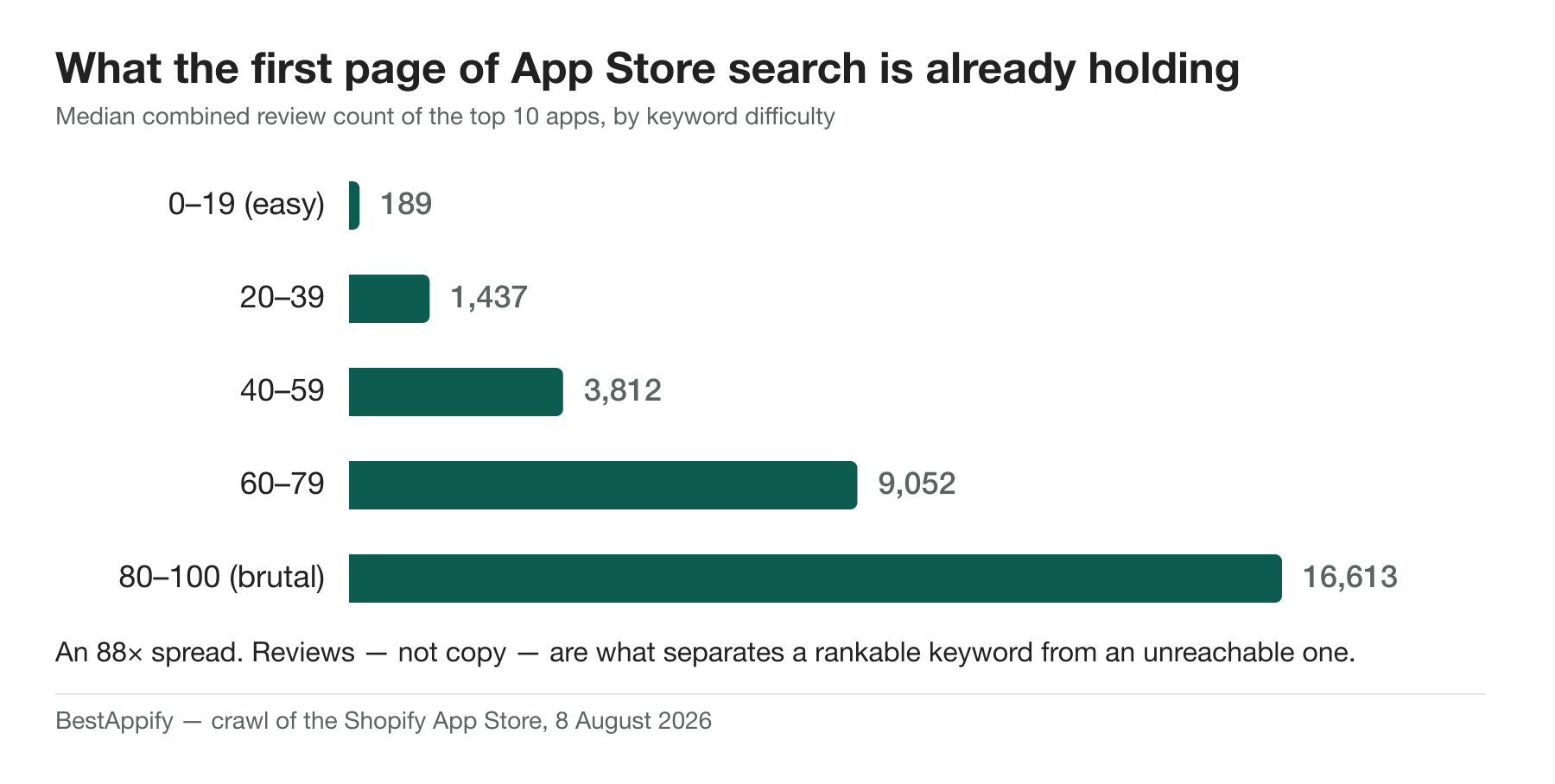
Read the first and last rows together. On an easy keyword, the entire first page is holding 189 reviews between all ten apps — an average of nineteen each. On a brutal one, it is 16,613, an 88× difference.
That is the whole game in one table. Ranking in the Shopify App Store is not primarily a copywriting problem. It is a social-proof problem, and copywriting is how you convert the traffic you get once you are already there.
If your app has 40 reviews, every keyword above difficulty 40 is a two-year project. Keywords below 20 are winnable this quarter.
Rating is table stakes, not a differentiator
Look at the rating column again: 4.82 on the easiest keywords, 4.90 on the hardest. The median rating of a top-10 app barely moves across the entire difficulty range.
That is because Shopify app ratings are compressed at the top of the scale — 62.3% of all rated apps sit between 4.9 and 5.0. A 4.9 does not make you stand out. A 4.3 gets you filtered out. Rating is a floor you have to clear, not a lever you can pull.
Review count, by contrast, spans four orders of magnitude across the store and is what actually separates page one from page four.
Where the winnable keywords are
Across the 1,741 non-branded keywords we have a difficulty score for, the distribution looks like this:
| Difficulty band | Keywords | Share |
|---|---|---|
| 0–19 (easy) | 210 | 12.1% |
| 20–39 | 369 | 21.2% |
| 40–59 | 638 | 36.6% |
| 60–79 | 457 | 26.2% |
| 80–100 (brutal) | 67 | 3.8% |
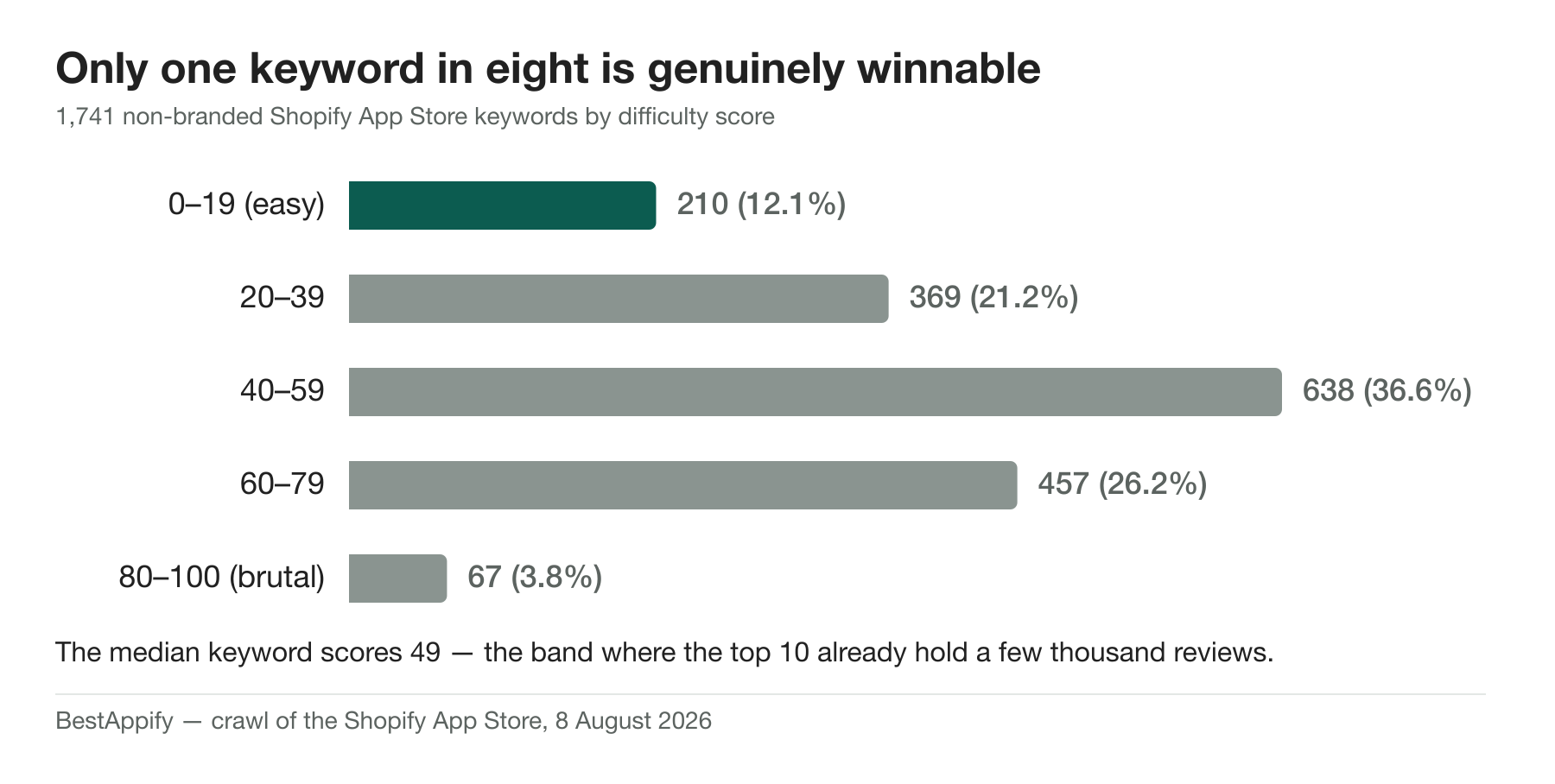
The median keyword scores 49. Roughly a third of the store's search demand sits at difficulty 40–59 — the awkward middle where the top 10 hold a few thousand reviews and a new app has no realistic path in.
The 210 easy keywords are the opportunity, and they are not the ones you would guess. Some real examples from our index, with the combined review count of everything currently ranking:
| Keyword | Difficulty | Demand | Top-10 reviews (combined) |
|---|---|---|---|
| google analytics 4 | 5 | 53 | 5,767 |
| breadcrumb | 7 | 57 | 6,777 |
| parcel | 9 | 46 | 3,243 |
| price calculator | 11 | 45 | 3,158 |
| merge orders | 15 | 48 | 3,948 |
| configurator | 13 | 45 | 3,162 |
| search and discovery | 7 | 42 | 2,427 |
Two things stand out. First, these are specific — "merge orders", not "orders". Second, they carry real demand: every one scores 42 or higher on our 0–100 demand scale, against a store-wide median of 48. These are not dead terms. They are terms the big apps never bothered to target because they are narrow.
What this means for your listing, concretely
Stop optimising for the category head term
"email", "products", "marketing" and "emails" all score 89–91 on difficulty, with the top 10 holding 22,000–68,000 reviews. You are not ranking there. Putting the word in your title costs you the space you needed for a term you could actually win.
Target the job, not the category
The easy keywords in our index are almost all descriptions of a specific job a merchant is trying to do: merge orders, calculate a price, add breadcrumbs, connect GA4. Merchants who search that way have a defined problem and convert far better than someone typing "marketing".
Build the review flywheel before you need it
Given the difficulty table, a review-acquisition process is not a nice-to-have you add later — it is the ranking strategy. Ask at the moment the app has just done something useful, not on install. Fix the problem first, then ask. Every review compounds: it lifts you on the keyword you have, which brings installs, which brings reviews.
Pick your category deliberately
Category assignment feeds relevance, and category sizes vary enormously — there are 822 shipping apps and 661 SEO apps in our catalogue, but only 30 in social proof and 25 in page builders. A smaller, precisely-matched category is worth more than a large, loosely-matched one.
Track weekly, not never
App Store rankings move constantly — a competitor's review push, a Shopify algorithm tweak, a new entrant. Most developers find out they dropped when installs dip a month later. Position history is the difference between diagnosing a change and guessing at it.
A realistic timeline by review count
Mapping the difficulty table onto where your app actually is today:
- 0–50 reviews. Target difficulty 0–19 only. There are 210 such keywords. Win three of them and you have a traffic base.
- 50–500 reviews. Difficulty 20–39 opens up — another 369 keywords, where the top 10 hold a median 1,437 reviews between them.
- 500–3,000 reviews. The 40–59 band becomes contestable. This is where the largest share of demand sits.
- 3,000+ reviews. You are now the incumbent someone else is reading this article about.
For scale: only 146 apps in the whole store have 1,000 or more reviews, and just 13 have more than 5,000. The bar for "established" is lower than it feels from the outside.
Methodology
Rankings come from our own daily crawl of Shopify App Store search results, covering 2,392 keywords harvested from App Store autocomplete, of which 1,781 are non-branded and 1,741 have a difficulty score. Difficulty is a 0–100 composite of the review volume, rating and position stability of the apps currently ranking. Demand is a 0–100 relative measure derived from autocomplete prominence, not an absolute search volume — Shopify does not publish those. Data as of 8 August 2026.
The short version
- Top-10 combined review counts run from 189 on easy keywords to 16,613 on hard ones. Reviews are the ranking currency.
- Median top-10 rating is 4.82–4.90 at every difficulty level. Rating is a floor, not a lever.
- Only 12.1% of keywords are genuinely easy — and they are specific job phrases, not categories.
- The median keyword scores 49. If you have under 500 reviews, most of the store is closed to you today.
We track daily App Store rank positions, competitor movements and keyword difficulty for app developers at bestappify.app. If you want to see where your app currently sits and which keywords are within reach of your review count, that is what it is built for.